P.Y.53 · P.Br.24
Rutile yellows and browns
Nickel rutile yellow, Y-608 to Y-503, and chromium rutile brown, BR-46 to BR-43. Rutile-structure pigments with outstanding hiding power and heat resistance to 1000°C.

Pigments & Colorants · Mixed Metal Oxide Pigments
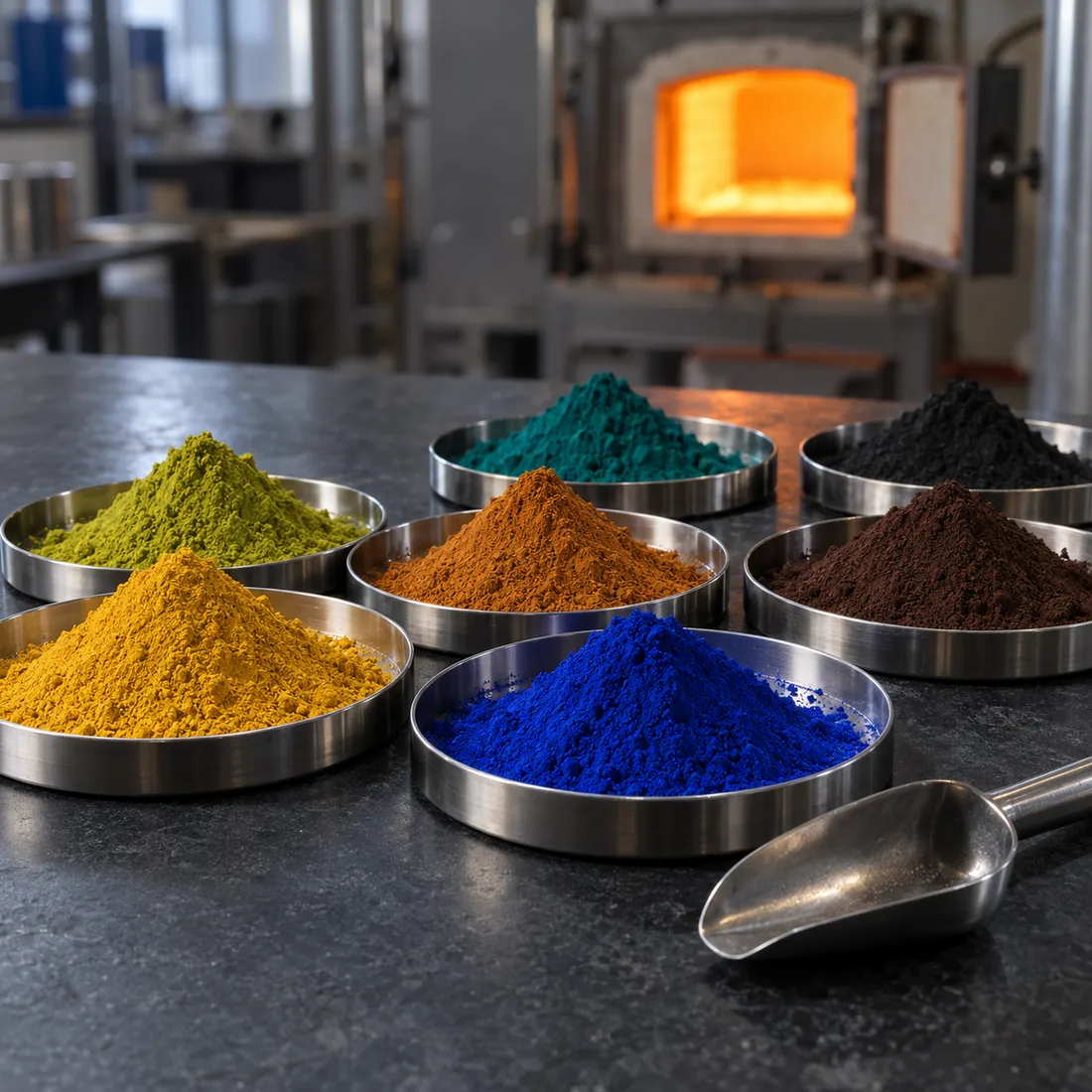
TRANSDUR pigments fuse nickel, chromium, cobalt or bismuth into a host oxide's crystal lattice above 800°C, so the colour survives what plain organic pigments can't. Six families, from nickel rutile yellow to encapsulated bismuth vanadate, each grade with heat resistance to 1200°C, light fastness 8 and weather fastness 5.
Product detail
Every TRANSDUR grade lists its C.I. Pigment number, density, oil absorption, average particle size, acid and alkali resistance, heat resistance, light fastness and weather fastness.
P.Y.53 · P.Br.24
Nickel rutile yellow, Y-608 to Y-503, and chromium rutile brown, BR-46 to BR-43. Rutile-structure pigments with outstanding hiding power and heat resistance to 1000°C.
P.B.28 · P.B.36 · P.G.50 · P.Br.29 · P.Bk.26 · P.Bk.28
Cobalt blue BL-84 to BL-51 and cobalt green G-4G to G-6G resist warpage in polyolefins; iron chromite brown BR-854 and BR-859; two black chemistries, one IR-reflective to cut heat build-up, one IR-absorbing.
P.Y.184
Y100, Y101 and Y106, a green-shade to reddish yellow with high tinting strength and, on Y101, a silica shell for extra heat and acid resistance in plastics.
Where it goes
Before you order
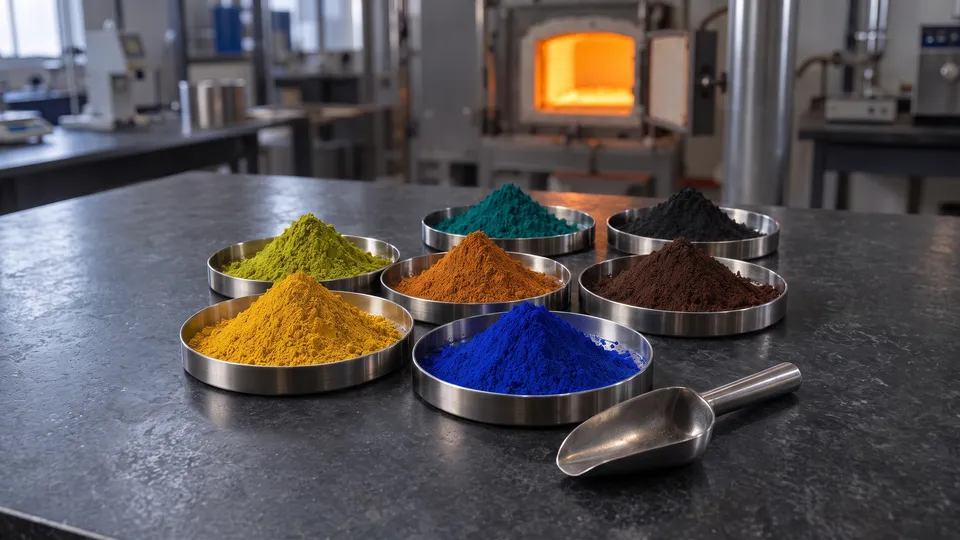
Pigments where a colouring metal, nickel, chromium, cobalt or bismuth, is fused into a host oxide's crystal lattice above 800°C, instead of sitting as a separate compound. TRANSDUR covers six such families, each grade rated for heat, light and weather fastness in the brochure.
A pigment built on the rutile crystal structure of titanium dioxide, with nickel or chromium filling defects in that structure for colour. TRANSDUR's nickel rutile runs Y-608 to Y-503 and chromium rutile BR-46 to BR-43, both rated for heat resistance to 1000°C.
A bright green-shade yellow used where high tinting strength, opacity and weather fastness matter more than cost: exterior paint, plastics and waterborne systems. TRANSDUR Y100 and Y106 cover the standard grades; Y101 adds a silica shell for extra heat and acid resistance in plastics.
No. The metal is locked inside the crystal lattice, not free as a soluble compound, so TRANSDUR pigments test under 2ppm solubility in stomach acid and are not classified as nickel, chromium or antimony compounds. That is why the range is cleared for food-contact plastics and toys.
Cobalt blue and cobalt green share the inverse spinel structure of the polyolefin's own crystallites, so they nucleate the polymer evenly as it cools instead of disrupting it. TRANSDUR's BL and G grades go into polyolefin masterbatch for exactly this reason.
Strategic partners
Write directly to the partner team, or send the short application. It reaches Hongda's partner team by email.
info@hongda-chem.comOr call the group directly: +86 574 87907888