
What Is Digital Printing Dye, and How Is It Different From Traditional Printing Dye?
Digital printing dye has to reach submicron dispersion, with far tighter filtration and viscosity control than traditional printing dye; reaching for a conventional grade in a pinch is what permanently blocks a print head.
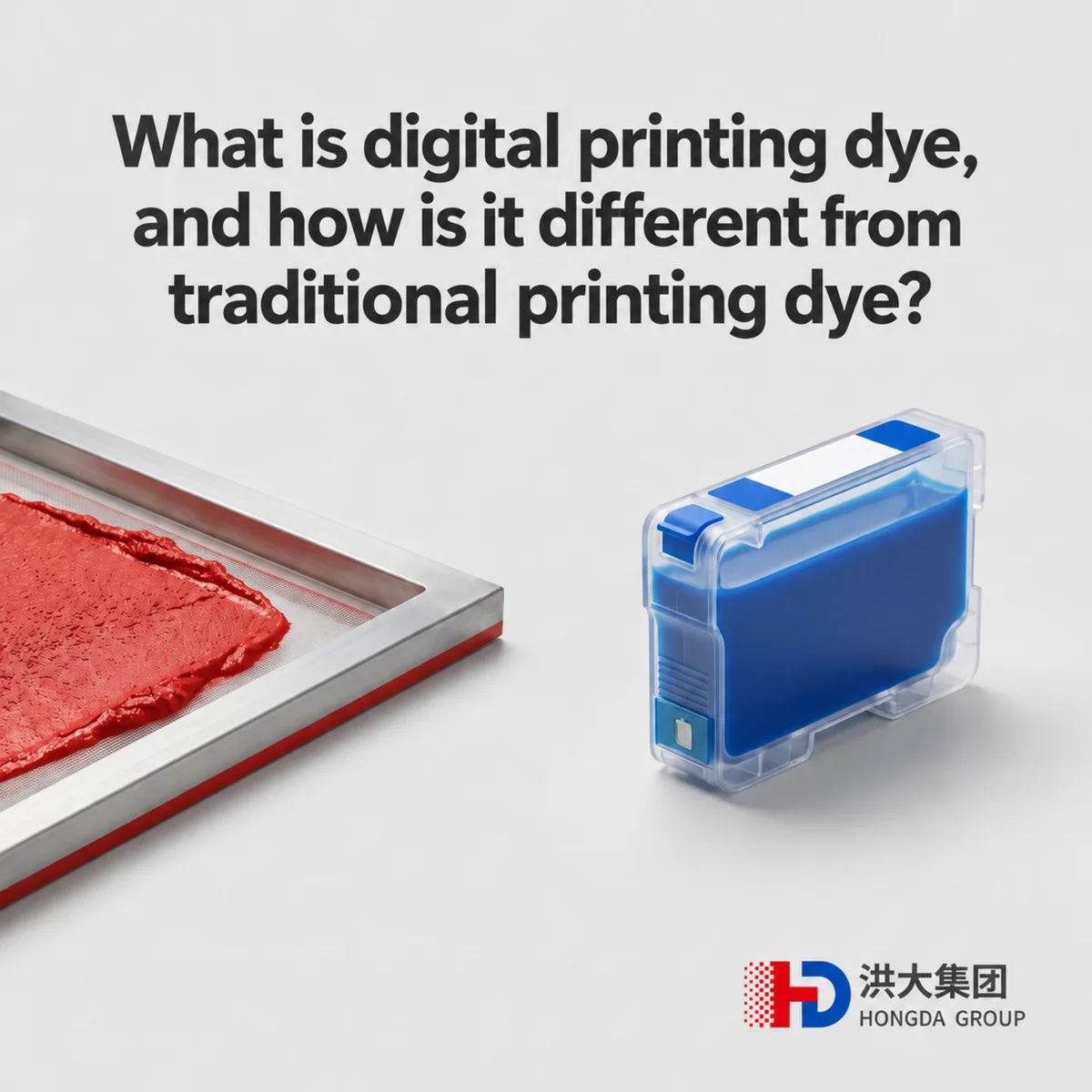
The technician in the digital printing room frowned at the clogged-nozzle alerts that kept popping onto the printer display. The order was on a tight delivery date, and the head had started dropping lines and losing blocks of color halfway through the run. It took hours of troubleshooting to trace the cause to a dye that had been swapped in at the last minute: to keep output moving, the floor had simply used a grade normally run on traditional printing. The whole set of prints was scrapped, and the delivery date slipped with it.
What is digital printing dye, and how is it different from traditional printing dye? Digital printing dye is formulated specifically around the way an inkjet print head works. Its particle size is far finer than that of traditional printing dye, and its filtration and viscosity control are considerably stricter. Traditional printing dye tolerates coarser particles, while digital printing dye has to reach an even submicron dispersion in order to pass cleanly through the microscopic structure of the nozzle plate.
The head of a digital printing machine carries thousands of micro-nozzles, and each one is typically only a few tens of microns across. If the dye particles run large, or if their size distribution is uneven, they build up inside the head, block the nozzle openings and produce dropped lines, missing color or blurred artwork. Rotary and flat screen printing tolerate particle size far more loosely, and slightly coarse particles do not affect the printed result, because the openings in a screen are much larger than the nozzles of an inkjet head.
Digital printing dye goes through finer milling and dispersion during production, holding particles steadily in the submicron range and keeping the size distribution tightly grouped so that no stray oversized particles end up in the liquor. Traditional printing dye only has to be milled below the screen opening size, so the precision demanded of the process is looser and the production cost lower with it. When we match color for a digital printing customer, we add a dedicated fine filtration and particle size inspection step, so that every batch we deliver reliably meets the pass-through requirement of the head.
Traces of impurity, or agglomerated particles, are hard to avoid entirely during the production and storage of any dye. For traditional printing, that kind of trace contamination generally causes no visible effect. For digital printing, even a very small quantity of out-of-spec particles can permanently block individual nozzles once it enters the head system, and the cost of repairing a head is usually far higher than the price of the dye itself.
Digital printing dye normally passes through several stages of precision filtration before it leaves the plant, removing micron and even submicron impurity particles step by step, and the sealing conditions are tightly controlled during filling and transport so the liquor is not contaminated a second time. Filtration requirements for traditional printing dye are more basic, aimed mainly at removing visible impurities and lumps. Feeding traditional printing dye straight into digital printing equipment without additional treatment can leave the actual impurity content far above what the head can tolerate, even when the liquid looks perfectly clear.
An inkjet head is exacting about the viscosity of the liquor it handles. Viscosity that runs too high keeps the liquor from ejecting cleanly through the nozzle, which shows up as ink starvation or tailing. Viscosity that runs too low lets droplets scatter, leaving jagged color at the edges of the artwork and reducing print definition. Changes in temperature and small swings in the solids content of the dye both register directly in the viscosity figure.
Digital printing equipment normally requires the liquor to stay within a fairly narrow viscosity band, and a workshop that warms or cools by a few degrees can push it outside that window. If solids content drifts because of a dosing error, viscosity moves with it, and the consistency of the jetting and the sharpness of the artwork follow. We advise digital printing customers to re-check viscosity and solids content on every incoming batch before use, so that the risk from a misapplied traditional dye or from poor storage conditions is ruled out ahead of production rather than during it.
We do not recommend mixing digital printing dye and traditional printing dye: the particle size, viscosity and purity standards of a digital grade are designed around the structure of the head, and a traditional grade cannot meet those physical requirements even when its chemistry is close. We advise customers to select the dye grade that matches the equipment type, and so avoid damaging the machine or scrapping a whole order. Digital printing dye normally costs more than traditional printing dye, and the difference comes mainly from how much more involved the manufacturing is: finer milling, finer dispersion, multi-stage filtration and stricter testing standards all add process steps and quality control cost that end up in the price. In our view that investment pays for itself by lowering equipment maintenance cost and scrap rate, which makes it economically sound over the long run. To judge whether a given dye suits a digital printing machine, we suggest verifying the particle size distribution data, the viscosity test report and the filtration specification before purchase, and asking the supplier for a compatibility statement written for inkjet equipment; we also suggest running a small sample print before committing to volume production, and going ahead only once the dye has behaved consistently on the actual machine.