
What Are Industrial Biocides, and How Do They Extend Product Shelf Life?
Industrial biocides are chemicals added to waterborne products and industrial water to kill or inhibit bacteria, yeasts and molds. They stop microorganisms from breaking down formulation components during storage and use, keeping viscosity, odor and color stable and thereby extending shelf life.
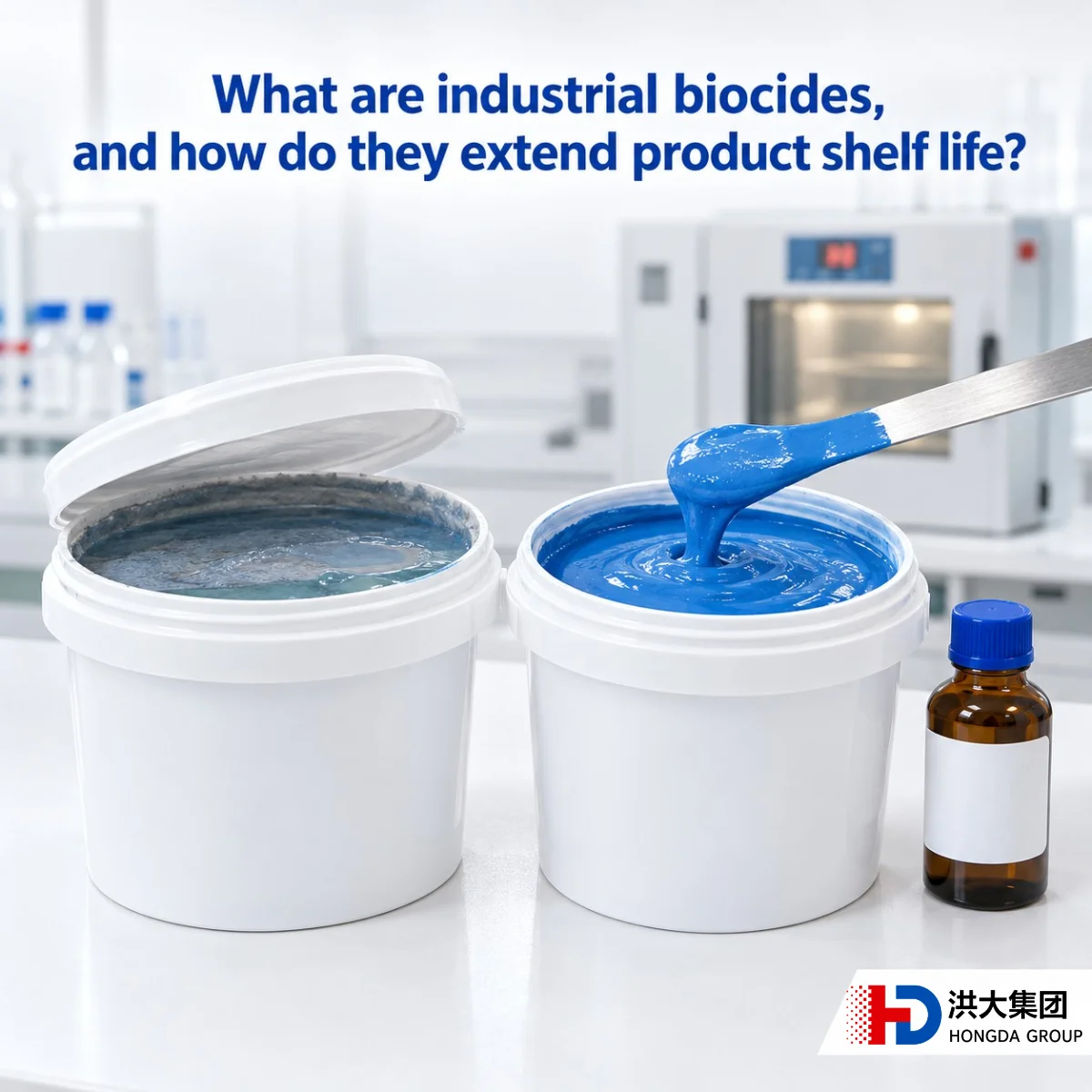
A waterborne colorant paste plant shipped its product to Southeast Asia for the first time. At final inspection, fineness, viscosity and color difference all passed, and the pails had no odor at all when opened. The container spent more than five weeks at sea and in port storage yards, and when it was opened on arrival, the distributor found that many pail lids had bulged; inside, the paste gave off a sour, rotten smell, had visibly thinned and had a layer of water floating on top. The whole container was sent back, and the distributor also claimed compensation for the coatings production it had already scheduled. The investigation traced the problem to two places: rinse water recycled on the plant floor had sat in a storage tank too long and was already contaminated, and the preservative in the formulation, adequate for the storage cycle in the domestic market, broke down quickly in the hot, slightly alkaline conditions inside the container and could not last through the long voyage.
What are industrial biocides, and how do they extend product shelf life? Industrial biocides are chemicals added to waterborne products and industrial water to kill or inhibit bacteria, yeasts and molds. They stop microorganisms from breaking down formulation components during storage and use, keeping viscosity, odor and color stable and thereby extending shelf life.
Any product that contains water is exposed to microbial attack from the day it leaves the plant. Emulsions, colorant pastes, waterborne coatings and inks, adhesives, metalworking fluids, pulp and personal care products all contain large amounts of water, along with nutrients microorganisms can use: cellulose thickeners, dispersants, surfactants, starch and a range of organic additives. Temperatures from ambient into the 30s °C and a neutral to slightly alkaline environment are exactly what most bacteria, yeasts and molds need to grow. Microorganisms also come from many sources: raw water and filler slurries, recycled process water, dead spots in pipes and tanks, rework, and the air and tools that reach the product once the customer opens the pail. Enzymatic breakdown and microbial metabolism are how a pail of product goes bad. Cellulases secreted by bacteria cut the molecular chains of cellulose ether thickeners, so viscosity keeps falling, followed by separation and settling. Organic acids and gases produced by microbial metabolism make the pH drift and the lids bulge, while sulfur- and nitrogen-containing metabolites bring a pungent smell; once the emulsion is destabilized it breaks, the color turns gray and dull, and mold spots grow on the pail walls and on the surface. In metalworking fluids, contamination causes emulsion breakdown, foul odors and corrosion of workpieces, and greatly shortens the interval between fluid changes. A product can pass inspection at the plant and still fail on arrival, because microbial growth has a lag phase. Colony counts at shipment may be very low and test results fully compliant; once the product sits in a warm warehouse or container, the population multiplies within days to weeks, and by the time the eye and nose can detect it, the product cannot be saved. Release testing only reflects the product's condition at that moment; shelf life depends on whether the product can keep resisting microorganisms throughout storage and transport.
A biocide stays in the product and protects it through the entire storage cycle. Industrial biocides remain in the product at very low addition rates and keep killing or inhibiting the microorganisms that enter the system. By mode of action, the common types fall roughly into electrophilic, fast-acting and oxidizing biocides. In practice, formulations usually combine grades with different modes of action to cover a broader spectrum of organisms. Electrophilic biocides deactivate key enzymes in microorganisms. Isothiazolinones are the most widely used class for in-can preservation and include BIT, MIT, CMIT/MIT, OIT and DCOIT. They react with thiol-containing enzymes inside microbial cells, shutting down respiration and metabolism, and the cells stop growing and die. CMIT/MIT acts quickly and has a broad spectrum, but its stability is poorer in systems with high pH, high temperatures, or amines and reducing agents; BIT is more stable under alkaline conditions and at higher temperatures, acts relatively slowly and is often paired with other grades. Fast-acting and oxidizing biocides treat process water and recirculating systems. Bronopol, DBNPA, glutaraldehyde and THPS act quickly and are suited to treating process water, pulp and recirculating water systems that are already contaminated. DBNPA breaks down quickly in water, even more so under alkaline conditions, so it suits shock dosing, and long-term protection of the finished product has to come from other grades. BCDMH releases bromine and chlorine; it is an oxidizing biocide used mainly in industrial recirculating water and cooling towers. In recirculating water and pulp systems, microorganisms also form slime that clogs pipes and lowers heat exchange efficiency, so biocides need to be used together with system cleaning.
In-can preservation and dry-film mold protection cover two different stages. In-can preservation runs from the moment raw materials are charged until the customer uses up the last pail. An in-can preservative has to dissolve in the water phase, be compatible with the product's pH and process temperature, and stay sufficiently active throughout storage. One of the problems at the paste plant at the start of this article was precisely that the preservative's stability range did not match the product's conditions. Products exported to hot, humid regions face higher storage temperatures and longer transit times, so both the grade and the dosage need to be reconfirmed under actual conditions. Once the customer opens a pail, every draw introduces new microorganisms, and the in-can preservative has to keep working throughout the period of use after opening. Dry-film fungicides and algicides protect paint films and putties after application. Exterior coatings, putties and wood stay exposed to moisture for long periods after application, and mold and algae grow on the surface, leaving black and green stains. Dry-film fungicides work from within the paint film; IPBC, carbendazim, OIT and DCOIT are commonly used against mold, and diuron and similar actives against algae. These grades need low water solubility to withstand rain washing, and they must also be lightfast and must not cause discoloration.
The wrong biocide, or the right one added the wrong way, can actually shorten shelf life. pH, temperature and formulation components can use up the active ingredients early. Adding a biocide during the hot stage of the process speeds up its breakdown, so it should be added after cooling and mixed in thoroughly. Amines and reducing agents such as sulfites in the formulation react with some isothiazolinones and gradually deactivate them during storage; if the spectrum of coverage is incomplete, surviving yeasts or molds will multiply again a few weeks later. Long-term use below the effective concentration can also let the microbial population in the plant gradually adapt to the biocides already in use. Plant hygiene matters too, because a biocide cannot replace a clean production environment. Biocide dosages are designed for a normal microbial load. When recycled water tanks, dead spots in pipes and rework stay contaminated for long periods, the microorganisms entering the product far exceed the design load, and even the best formulation will fail early. Regular cleaning of tanks and pipes and monitoring of colony counts in process water are as important as choosing the biocide.
Challenge tests and residue analysis should determine the formulation. Evaluating a biocide means simulating the conditions the product will actually face. A challenge test inoculates the sample repeatedly with bacteria, yeasts and molds and counts them at regular intervals to determine whether the preservation system can keep microorganisms under control; the test should be repeated on samples after heat storage to simulate warehousing and ocean shipping, and for export products, the storage temperature and duration are best set with reference to the actual shipping route. Preservative residue testing confirms how much active ingredient remains after storage. The Vicente testing center at Ningbo Reayoung, part of Hongda Group, can test for preservative and formaldehyde residues and run microbial identification, colony counts, inhibition zone tests and microbial challenge tests. Biocide use is subject to regulations in each market, so before your first order, please confirm the registration status of the active ingredient in your target market and request the safety data sheet.
Once a product already smells, can adding more biocide save it? Adding more biocide can stop microorganisms from multiplying further, but the acids, gases and odor already produced, and the thickener already broken down by enzymes, cannot be restored. Badly contaminated batches should first be assessed to see whether they can be reworked, while the source of contamination is traced at the same time; simply adding more biocide often just postpones the problem. Do solventborne and powder products need biocides as well? Solventborne products and dry powders carry a lower risk of contamination in the container and generally do not need an in-can preservative. Powdered raw materials can carry spores, however, and once they are mixed with water they become part of a waterborne system and need the same protection as a waterborne product; solventborne exterior coatings also grow mold after application and still need a dry-film fungicide. How should biocides be chosen for export to different countries? First confirm which active ingredients the target market allows, along with the corresponding limits and labeling requirements, and then set the grades and dosage based on the local climate and transit time. We provide the CAS number, assay and safety data sheet for every active ingredient, so you can check each one against the regulatory requirements of your target market.
Hongda Group has manufactured and exported chemicals in Ningbo since 1992, selling to more than thirty countries. Our Vicentecide biocides and preservatives include more than forty actives with CAS numbers, as well as formulated ranges for in-can preservation, dry-film mold and algae protection, personal care blends and silver-based antimicrobials, covering industrial, household and personal care, and water treatment applications. If your waterborne products have ever developed odors, bulging containers or viscosity loss, or you are preparing to export to hot, humid regions, tell us about your formulation system, pH, production process and target market, and we will work out the biocide combination and dosage together. To learn more about working with us, visit hongda-chem.com, click "Become a strategic partner" and contact us via WhatsApp or WeChat.