
Why Do Lightfastness and Weather Resistance Matter So Much in Outdoor Applications?
Lightfastness is a pigment's ability to hold its color under light; weather resistance is its ability to hold color and performance under light, heat, moisture and oxygen acting together. The color life of any outdoor product is decided by these two properties, and neither of them can be seen on a laboratory draw-down.
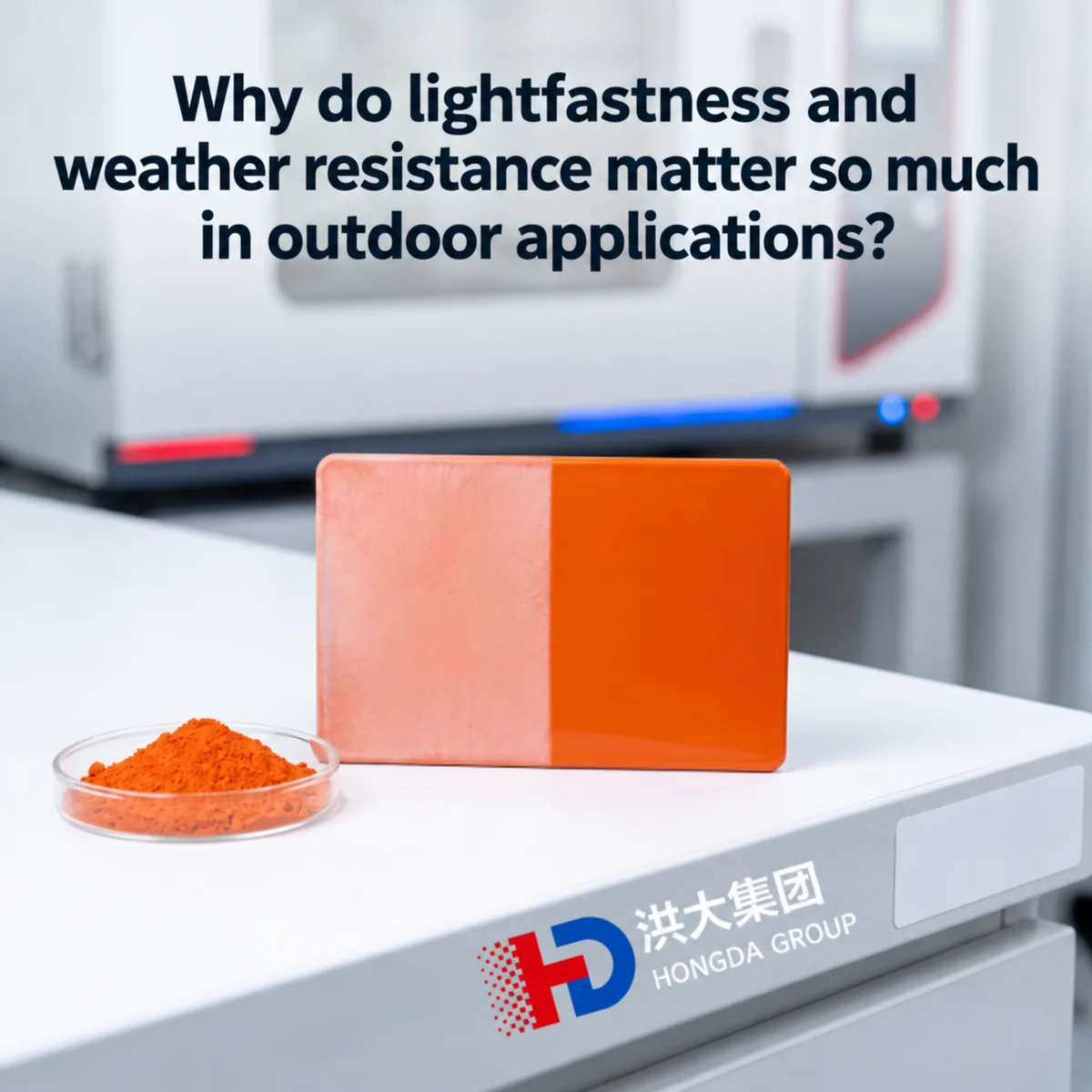
Six months after a batch of outdoor plastic seats was delivered, the customer sent photographs: the once vivid orange-red had faded to a pale pink, and the sunlit side and the shaded side looked like two different products. The formulation had not changed, and the pigment's color index number was identical to the one used in the laboratory sample. The problem came from the selection stage, where nobody had asked how long that pigment would last under ultraviolet light, rain and heat. The whole batch had to be replaced, and the customer demanded weathering test reports for every order from then on.
Why do lightfastness and weather resistance matter so much in outdoor applications? Lightfastness is a pigment's ability to hold its color under light exposure; weather resistance is its ability to hold both color and performance when light, heat, moisture and oxygen act together. The color life of an outdoor product is decided by these two properties, and neither of them shows on a laboratory draw-down.
A pigment's color comes from the selective absorption of light by its molecular structure, and the outdoor environment attacks that structure every day: ultraviolet radiation breaks the chemical bonds of organic pigments, heat accelerates the process, and moisture and oxygen trigger hydrolysis and oxidation. The change does not happen in a day; over months the color fades, darkens or drifts, until the customer holds two panels side by side and sees the gap. Ultraviolet light carries enough energy to break the chromophores of many organic pigments, and once a chromophore is broken the molecule can no longer absorb its specific wavelength, so the color weakens. Organic pigments of different structures vary enormously in their ultraviolet resistance, and within the same hue a low-cost grade and a high-performance grade can differ several times over in outdoor life; inorganic pigments do not rely on organic chromophores and have a natural advantage here. Many buyers look only at the lightfastness rating, yet outdoors there is also temperature, rain, humidity and airborne pollutants. Heat speeds up every degradation reaction; moisture hydrolyzes certain pigments and also ages the coating or the plastic matrix itself, exposing more pigment surface; oxygen and ozone take part in oxidation. Weather resistance is the question that covers all of these together, and a pigment with a very high lightfastness rating but insufficient heat or hydrolysis resistance will still fail outdoors in a hot, humid region.
Both properties have mature evaluation methods, and at purchasing time the supplier should be asked for the corresponding data rather than judged on color index and price alone. Lightfastness is normally rated on the blue wool scale from 1 to 8, with 8 the highest: the pigment panel is exposed alongside standard wool strips, and the rating corresponds to the wool strip that shows the same degree of fading at the same time. Each step up roughly doubles the exposure time before fading, and outdoor applications generally call for grade 7 or above, with attention to the concentration at which the rating was measured. Weather resistance is evaluated in accelerated aging equipment, most commonly xenon-arc and fluorescent UV chambers, which control irradiance, temperature, spray and humidity to simulate outdoor conditions and report color difference and gloss retention per hour of exposure. Accelerated data are convenient for comparison but do not fully replace real outdoor exposure, especially for long-term projects, so for products with demanding outdoor life requirements we recommend running both. The point most often overlooked is concentration: the same pigment rated in masstone, without white, and the same pigment reduced with titanium dioxide to a pale shade often differ by one or two grades or more, because after reduction a greater share of each pigment particle is exposed to light and breaks down faster. If an outdoor product uses a light shade, the supplier must be asked for data at the actual reduction ratio; otherwise the high masstone rating is only a number on paper.
Inorganic pigments such as the iron oxides, surface-treated rutile titanium dioxide and complex inorganic color pigments generally offer very high outdoor durability and stable color, at the cost of a limited hue range and lower saturation than organics. Organic pigments are vivid and strong in tinting, but their weather resistance spans an enormous range: high-performance families such as quinacridones, diketopyrrolopyrroles and perylenes meet automotive coating requirements outdoors, while some low-priced azo grades are suitable only for indoor use. A common purchasing mistake is to buy by color index number on the assumption that every product under that number performs the same. In reality, products under the same index from different manufacturers and in different grades differ in particle size, crystal form, surface treatment and purity, and their weathering performance can be completely different. Outdoor applications should be selected on weathering data and actual test results, not on the index number alone.
The selection sequence should be to define the conditions first, then choose the pigment, and finally match the system; done in the reverse order, the problems surface after delivery. Start by fixing the service life and the exposure conditions: how many years outdoors, and in which region, since coastal high-humidity high-salt environments, high-altitude intense ultraviolet and polluted industrial zones are entirely different cases. Once life and region are fixed, the required lightfastness grade and weathering hours have a basis, and the supplier can recommend suitable grades. Consider the pigment together with the system: plastic articles need matching ultraviolet absorbers and hindered amine light stabilizers to protect the matrix and the pigment; in coatings the resin system decides how long the film itself lasts, and if the resin chalks first, even the best pigment will be exposed; titanium dioxide needs suitable surface treatment to suppress photocatalytic chalking. When we recommend pigments for outdoor use, we look at the customer's matrix, additives and processing conditions at the same time. The final judgment can only come from panels made with the actual formulation, at the actual concentration and under the actual processing conditions, run through accelerated aging and, where necessary, outdoor exposure. The time and cost of that step are far below the cost of reworking a faded batch of outdoor product.
Is a pigment rated 8 on the blue wool scale automatically safe outdoors? Not necessarily: grade 8 is usually the masstone figure, and after reduction to a pale shade it can drop to 6 or lower, and lightfastness reflects only the effect of light, while outdoors there is also heat, moisture and oxygen, so weathering data at the actual concentration are required. Are inorganic pigments always more weather resistant than organics? In most cases yes, but not absolutely: high-performance organic pigments can meet automotive coating requirements outdoors, while some untreated inorganic pigments run into trouble in humid environments, so selection has to rest on the data for the specific grade. Do indoor products need to consider lightfastness at all? They do: positions by a window or under the strong lighting of a shopping mall will fade low-lightfastness pigments, only more slowly than outdoors, and indoor products generally require grade 5 to 6 depending on the setting.
Hongda Group has produced pigments, titanium dioxide and additives in Ningbo since 1992, exporting to more than thirty countries, with a large share of that output going into outdoor coatings and plastic articles. If your product is meant for outdoor use, tell us the service life, the region and the formulation conditions, and we will recommend grades for your actual case and provide weathering data. To learn more about working with us, visit hongda-chem.com and click "Become a strategic partner".