
How Do You Check That a New Dye or Pigment Works in Your Existing Formula When You Change Suppliers?
To confirm that a new product is compatible with your existing formula, work in four steps: check its identity and composition on paper, run a side-by-side lab comparison with your existing formula and process, run a small production trial, and finally sample and retain the first commercial shipment. A close color match is only the first hurdle; dispersion, processing and fastness each need to be confirmed one by one.
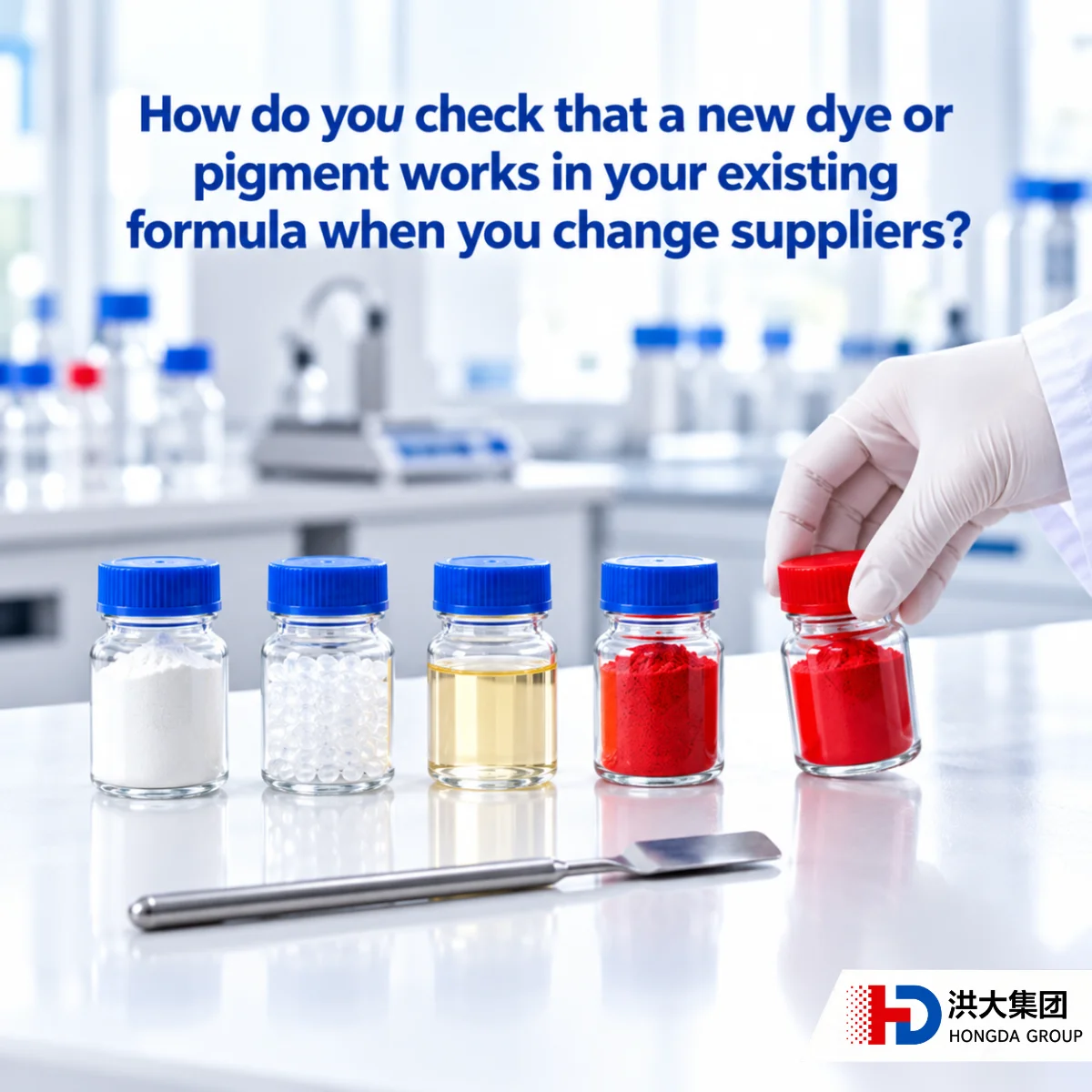
A masterbatch producer in Eastern Europe wanted to spread its supply risk, so it replaced a commonly used organic red pigment with another supplier's product carrying exactly the same Colour Index number. The lab made a color plaque and compared it with the old product; the shade was almost indistinguishable, and production switched over the following month. Once the first lot of masterbatch reached customers, the filter screens on one customer's blown film line had to be changed more and more often, melt pressure kept climbing, and color specks started to appear on the film. Another customer, which molds polyethylene crates, saw obvious warpage in its parts. The investigation showed that the new pigment's particle size and surface treatment both differed from the old one: it would not disperse with the existing dispersant and processing conditions, and it affected crystallization in polyethylene differently. The masterbatch producer had to recall two lots, compensate its customers for downtime and switch back to the old pigment. At the time, the lab had compared only color and had tested none of the formula's other properties.
How do you check that a new dye or pigment works in your existing formula when you change suppliers? To confirm that a new product is compatible with your existing formula, work in four steps: check its identity and composition on paper, run a side-by-side lab comparison with your existing formula and process, run a small production trial, and finally sample and retain the first commercial shipment. A close color match is only the first hurdle; dispersion, processing and fastness each need to be confirmed one by one.
The same Colour Index number can behave very differently once it goes into your formula. The Colour Index (C.I.) number and the CAS number describe the chemical structure. The same structure, made in different plants, can differ in crystal form, particle size distribution, surface treatment and impurity levels. Before dyes leave the factory, they are also standardized to the maker's own strength with sodium sulfate, dispersants and similar diluents, and each maker standardizes in its own way. Your existing formula was tuned step by step around the old product: dispersant dosage, grinding time, processing temperature and dyeing curve all fit its characteristics. Batch consistency and shipping documents have their own articles on this blog; this one covers how to confirm that a new product fits your existing formula when you change suppliers.
Before you switch, rule out obvious differences on paper. Technical and safety data sheets: identity, crystal form and composition. Put the technical data sheets from the old and new suppliers side by side and compare them item by item: Colour Index number, crystal form, heat resistance, lightfastness, oil absorption and recommended systems. For titanium dioxide, also compare rutile or anatase grade and the aluminum, silica or organic surface treatment. Section 3 of the safety data sheet lists the composition; if the new product contains an extra solvent, carrier or dispersing aid, find out before you make any samples. For solvent-based systems, check solubility as well: our metal complex dye brochure lists their solubility in alcohols, glycol ethers, MEK, ethyl acetate and toluene, so you can check compatibility before you order. Downstream approvals: which customers need advance notice. Some customers require approval of raw material sources, and food contact, toy and electrical and electronic applications need test reports for each use. Changing the source of a pigment or dye may trigger change notification clauses in your customer contracts. Go through your customers' specifications first and list the products that need re-approval; that is what lets you schedule the validation plan accurately. For products with long approval cycles, you can try the new material first on products with fewer requirements while you prepare old-versus-new comparison data for key customers.
Side-by-side lab comparison: same formula, one raw material changed at a time. Shade and tinting strength: compare with the same formula and the same instruments. Using a retained sample of the old product and the new sample, make samples with the same formula, on the same equipment, on the same day, and read the color difference in CIELAB color space with a spectrophotometer, looking separately at the shifts in lightness, chroma and hue. Compare under at least two light sources, such as D65 and illuminant A, to rule out metamerism. Compare tinting strength against the old product: if the new product is weaker, you will need more of it, and if it is stronger, you can use less, so compare prices per unit of tinting strength. Judge color difference with the same tolerances you give your own customers. Tints reduced with titanium dioxide magnify differences in tinting strength and hue the most, so make them alongside the masstone. Dispersion and rheology: a new pigment may need a different dispersant or grinding time. For coatings and inks, compare fineness of grind, viscosity, gloss and stability after storage, and use a rub-out test to check for flocculation. For masterbatch and plastics, run a filter pressure test, then blow a short run of film or press a plaque and look for specks and undispersed particles. When the new pigment's surface treatment differs from the old one, the existing dispersant may fail to adsorb onto it, and longer grinding will not make up for that. Tinting paints and multi-pigment systems also need a check for floating and flooding: the new pigment may flocculate differently from the other pigments in the formula, so the dry film color can differ from the wet film. For liquid products, run a set of heat-aged storage tests and check for changes in viscosity, settling and shade. Dye compatibility: in a combination shade, exhaustion rates must be similar. In trichromatic dyeing, the dyes must exhaust together to give an even, reproducible shade. When you replace one of them, take samples at each stage of the original dyeing curve and compare exhaustion rates as well as sensitivity to temperature, pH and salt. Cationic dyes for acrylic are combined by K value and F value: our Dragonacrylic shade card lists both values for every shade, so you can compare them directly when you substitute one.
If you compare only color and skip performance tests, problems show up at your customer's plant. Heat resistance, migration and the effect on polyolefin shrinkage. Test pigments for plastics at your actual processing temperature and residence time, and check flexible PVC for migration and blooming. Some organic pigments act as nucleating agents in polyethylene and polypropylene and change part shrinkage, which makes large injection-molded parts warp, as happened with the crate customer in the opening story. Verify this kind of problem with the customer's actual mold or a similar part, because a color plaque will not show it. Fastness: test the old and new products together, with your original methods. Retest textiles with the ISO 105 methods you already use, such as ISO 105-B02 for light, ISO 105-C06 for washing and ISO 105-X12 for rubbing; test coatings and plastics with your original lightfastness and weathering methods. Results are comparable only when the old and new products go into the same test run. For disperse dyes on polyester, also watch thermal migration and sublimation; when the heat-setting temperature changes, the difference between the old and new product becomes more visible. Comparing the new product's measured values with the typical values on the old product's technical data sheet tells you very little.
After the lab, the production line is the next test. Once the lab trial passes, run a production trial with your normal equipment and batch size, record the processing parameters and compare them with the lab results. The production trial should cover your most frequently used formulas and your hardest colors, with one set each for dark and light shades and for high and low loadings. When the first commercial shipment arrives, sample it against the COA, keep retained samples, and seal a new standard sample jointly with the supplier. Keep part of your old product inventory until several lots have proven stable, and only then switch completely. Our samples and technical answers come directly from the team that makes the product, and formula advice and comparison samples against your existing standard are part of the partnership from the first order; our ultramarine brochure also compares each grade with traditional ultramarine by color difference and tinting strength.
If the new sample matches the old product's color, do I still need the full set of tests? You need the key tests for your application. Color reflects only some of the product's properties; dispersion, heat resistance, migration, fastness and the effect on processing each have to be confirmed separately. You can rank them by risk: test first what is most likely to go wrong and what your customers care about most, then fill in the rest. The new product has higher tinting strength. Can I simply reduce the dosage? You can adjust the dosage in proportion to tinting strength, and then validate again. When the dosage changes, the pigment-to-dispersant ratio, the viscosity and the gloss of the system all change with it, and the shade may shift. When you compare prices per unit of tinting strength, include the cost of these adjustments. How long does the whole validation take? It depends on the application. Lab color matching and dispersion tests are fast; weathering, storage and fastness tests take longer, and re-approval by downstream customers is often the slowest step. Start validation while you still have plenty of the old product in stock, so you are never forced to switch without data.
Hongda Group has manufactured and exported chemicals in Ningbo since 1992, selling to more than thirty countries and working with more than five hundred distributors worldwide. Our textile dyes, organic and inorganic pigments, titanium dioxide and auxiliaries are each handled by a dedicated business unit, and our shade cards and product brochures list Colour Index numbers, fastness and recommended systems, so you can compare item by item before you switch. If you are considering a new source for the dyes or pigments you use now, tell us your current grades, formula system, processing conditions and end use, and the relevant business unit will recommend replacement grades, arrange samples and make comparison samples against your standard. To learn more about working with us, visit hongda-chem.com, click "Become a strategic partner" and contact us via WhatsApp or WeChat.