
What Are the Steps in the Complete Polyester Dyeing Process?
The complete polyester dyeing process has nine steps in three stages. Before dyeing come pretreatment, presetting and lab dip color matching; during dyeing, dyebath preparation, heating and holding, and cooling and draining; after dyeing, reduction clearing, drying and heat setting, and final inspection. Every step affects the shade, levelness and fastness of the finished goods.
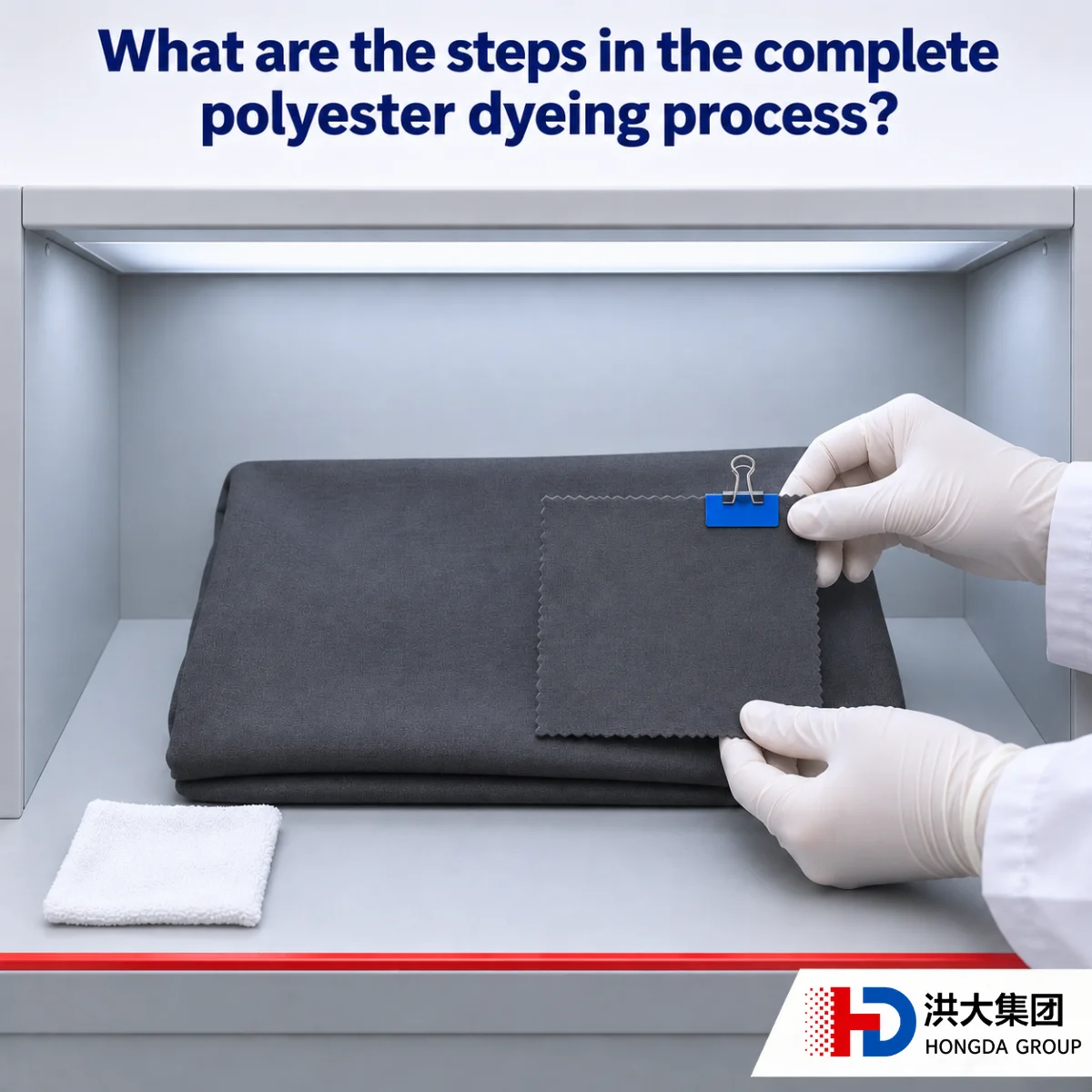
A knitted fabric mill took an order for dark gray polyester sportswear fabric with a delivery window of only ten days. To save time, the shop floor merged scouring and presetting of the greige fabric into a single simple hot water wash, and replaced reduction clearing after dyeing with one rinse in clean water. The lab dip passed color matching without trouble, and the bulk batch matched the shade when it came out of the machine. The problems showed up later. After heat setting, the fabric showed patches of light-colored oil marks and an uneven width, and when the customer ran a rubbing fastness test, wet rubbing reached only grade 2. The entire lot was returned. After stripping and redyeing, the hand turned stiff and part of the fabric had to be downgraded. Of the two steps that were skipped, one left spinning oil behind and the other left unfixed surface dye, and the cost far exceeded the few hours saved.
Nine steps in three stages, and the hours in the dyeing machine cover only the middle one. Many dyehouses focus their attention on the few hours inside the dyeing machine. A batch of polyester goes through three stages on its way from greige goods to finished product, before, during and after dyeing, with three steps in each. The three steps before dyeing decide what kind of fiber the dye lands on, the three steps during dyeing decide whether the dye can enter the fiber, and the three steps after dyeing decide whether the color stays and remains stable. Each step is explained below in order, with separate notes where yarn and fabric differ.
Three steps before dyeing: if the fiber is not ready, even the best dye will not go on evenly. Step 1, pretreatment: removing oils and size. Polyester filament receives spin finish during spinning and texturing, warp yarns are sized for weaving, and knitting uses knitting oil. These oils, sizes and the dirt picked up in transit sit on the fiber surface, block the dye and cause light patches and streaks. Pretreatment washes them off with a scouring agent and a suitable amount of alkali at a set temperature, and woven greige fabric is desized first. Two indicators show whether pretreatment worked: whether the fabric's wicking (water absorbency) is uniform, and whether residual oil is within specification. Silk-like products also go through alkali weight reduction at this step; if the degree of reduction varies, the fiber surface varies, and so does the color yield later. Step 2, presetting: stabilizing dimensions and fiber structure. Before dyeing, the fabric runs through a stenter, where tension and high temperature fix its width, density and shrinkage and relieve the internal stresses left by weaving or knitting and pretreatment. Presetting gives all the fiber in a lot the same heat history, which is what makes the rate and depth of dye uptake consistent. If the presetting temperature or speed drifts, different sections of the same roll show shade differences and streaks. Yarn dyeing has no presetting step; its counterpart is soft winding, which winds the yarn evenly onto dye tubes so that the package density is uniform and the dye liquor can flow evenly through the yarn layers. Step 3, lab dips and color matching: a recipe confirmed on a small sample gives the bulk batch a basis. Before a bulk batch starts, the lab makes small samples against the customer's standard or color number to set the dye combination and amounts. Lab dips should use the same fiber, greige fabric with the same pretreatment and the same process curve as the bulk batch; the more the lab and bulk conditions differ, the larger the deviation after scaling up. Color matching is done in a standard light booth under at least two light sources, to avoid metamerism, where a shade matches under one light and jumps under another. The dyes in a combination shade should have similar uptake rates, and the classification of disperse dye types is the starting point for selection. Hongda's textile business unit provides samples and technical data and runs lab dips against your existing standards, so the recipe is proven on your process before it is scaled up to bulk.
Three steps during dyeing: this is where it is decided whether the dye can enter the fiber. Step 4, preparing the dyebath. Disperse dyes do not dissolve in water. To prepare the bath, first make the dye into a smooth paste with warm water, then add it to the machine through a filter screen, so that undispersed particles do not enter the liquor and cause color specks. The dyebath also contains three kinds of auxiliaries: a dispersant keeps the dye particles fine and stable, a leveling agent controls the uptake rate, and an acid such as acetic acid brings the bath to weakly acidic. The pH of the dyebath has to be set before heating. Hongda's disperse dye manual lists the suitable pH range by series, for example 4 to 10 for the AC-E series and 3 to 8 for the UN-SE series, so prepare the bath within the range of the dye you use. Step 5, heating and holding for dye uptake. Once the dye liquor circulates evenly, the machine is sealed and heated up to the high-temperature stage, where it holds. Hongda's product literature records the route most mills use: high-temperature, high-pressure overflow dyeing at about 130°C, followed by reduction clearing. Temperature and time are the two conditions for dye to enter the fiber, and the high-temperature, high-pressure method relies on exactly these two conditions to move dye into the fiber. Watch two records at this step: whether the actual temperature follows the process curve, and whether the holding time is long enough. In yarn dyeing, also check the main pump's flow rate and flow reversal; in fabric dyeing, check fabric speed and load. If circulation falls short, the liquor does not reach the inside of the yarn package or the folds of the fabric. Step 6, cooling and draining. After the hold, the bath is cooled. If fabric cools too fast, the fiber sets quickly in its folded state and leaves crease marks that are hard to remove. Cool at the rate set in the process, and drain only after the bath has reached a safe temperature and the machine has been depressurized. Where the equipment allows and operation stays safe, draining at a higher temperature reduces oligomer deposits on the fabric and the machine walls. After draining, take a sample to check the shade. A small deviation can be corrected at this step by adding dye; a large deviation calls for finding the cause first, because repeated additions only make the color more uneven with each correction.
Three steps after dyeing: surface dye and heat setting decide whether the color stays. Step 7, reduction clearing. When dyeing ends, some dye that never entered the fiber stays on its surface. This is unfixed surface dye. It comes off during washing and rubbing and causes color loss and staining. Medium and dark polyester shades need reduction clearing after dyeing: under alkaline conditions, sodium hydrosulfite (sodium dithionite) reduces and destroys the disperse dye on the surface, followed by a hot rinse, a cold rinse and finally neutralization with acid to weakly acidic. Light shades can use soaping instead. Set the concentration, temperature and time of reduction clearing by depth of shade; too little leaves surface dye behind, and too much washes the color lighter. Step 8, drying and heat setting. After clearing, the fabric is hydroextracted, dried and then heat set on the stenter as a finished product, and finishing agents such as softeners are applied at this step. Finish setting is a dry heat treatment at a temperature higher than the dyeing temperature. Dyes with insufficient sublimation fastness leave the fiber at this step, the fabric changes shade, and the guide rollers and the next lot of fabric get stained. Softeners can also draw dye from inside the fiber to the surface, causing thermal migration, which lowers wet rubbing and washing fastness. For fabrics that need high-temperature setting, choose heat-resistant dyes at the lab dip stage. Hongda's CXF series has sublimation fastness of grade 4 to 5 at 180°C and suits fabrics that need heat setting and high-temperature washing. Step 9, final inspection. Two types of indicators are checked before shipment. The first is color: compare against the standard under standard light, measure the color difference, and check consistency between the head and tail of a roll, across left, center and right, and between batches. The second is fastness: test fastness to washing, rubbing, sublimation, perspiration and light according to customer requirements. Keep the inspection data with the process records of each batch, so that if a complaint comes in, the problem can be traced back to the step where it started.
Under the tightest deadlines, three steps are the first to be cut. When a delivery date is tight, the first things squeezed are pretreatment, holding time and reduction clearing. Problems in these three steps do not show when the batch comes out of the machine. They surface after heat setting, when the customer runs fastness tests, or after the garments have been washed a few times. That is what happened with the dark gray fabric at the start: the few hours saved turned into returns and redyeing. We recommend writing the key parameters of these three steps into the process card as mandatory checks for every batch, and following them however tight the deadline.
How does the process for yarn dyeing differ from fabric dyeing? The main process is the same; the differences lie in the steps before dyeing and in the equipment. Yarn dyeing adds soft winding before pretreatment and has no presetting, and the main pump forces the liquor through the yarn layers. Fabric dyeing includes presetting, and the liquor and fabric move against each other in an overflow or airflow dyeing machine. Yarn dyeing has to control package density and main pump flow; fabric dyeing has to control load, fabric speed and cooling rate to prevent creases. Can reduction clearing be skipped? Light shades can use soaping instead, but medium and dark shades cannot skip it. Reduction clearing removes surface dye from the fiber; without it, fastness to wet rubbing, washing and perspiration drops, and during heat setting the surface dye also causes staining. To judge whether the clearing conditions are right, look at the fastness test results: the conditions pass only when fabric samples made with the bulk process meet the fastness the customer requires. How should the dyeing process for polyester/cotton blends be arranged? Polyester/cotton blends are dyed in two steps: first the polyester with disperse dyes at high temperature, then the cotton with reactive dyes. Reduction clearing between the two steps has to take the cotton portion into account, and residual disperse dye and sodium hydrosulfite must be cleaned out before the cotton is dyed. Shortened processes such as one-bath dyeing work with a narrower range of dyes and shades, and every shade needs its own lab dip to verify it.
Hongda Group has manufactured and exported textile chemicals and colorants in Ningbo since 1992, selling to more than thirty countries and working with more than five hundred distributors worldwide. Our disperse dyes cover the E, SE and S types, and the manual lists the depth of shade and full fastness data for every shade. If your polyester dyeing keeps running into problems at one particular step, tell us your fiber specifications, equipment type, process card and target color, and our textile business unit will advise you on both dye selection and process and arrange samples. To learn more about working with us, visit hongda-chem.com, click "Become a strategic partner" and contact us via WhatsApp or WeChat.