
Can Solvent Yellow 114 Be Blended with Organic Pigments?
Solvent Yellow 114 can be blended with organic pigments, but only in suitable scenarios. This article explains how the two color differently, where blending works and where it is not recommended, and the practical points to control.
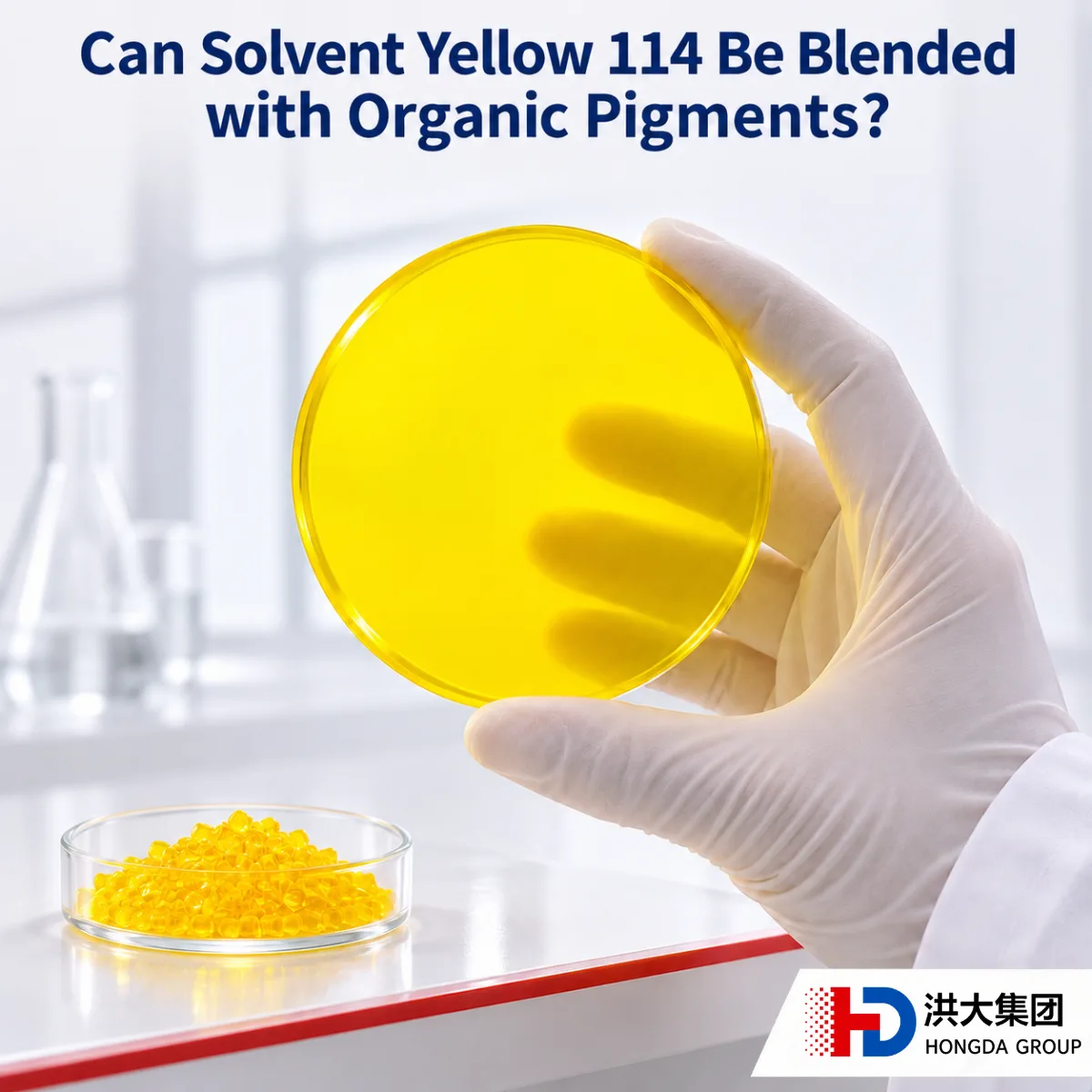
[A real customer question] An everyday question from color matching technicians: when making plastic masterbatches or formulating transparent inks, Solvent Yellow 114 offers high transparency and a bright shade. Can it be blended with organic pigments to make up for the performance shortcomings of a single dye or pigment?
[The direct answer] Yes, it can be blended, but only by distinguishing scenarios and following the rules. It is a color matching solution that is “controllable, but with a threshold.”
Blending Solvent Yellow 114 with organic pigments is an advanced technique commonly used in plastics coloring and specialty ink formulation. It keeps the high transparency and brightness of the dye while using the pigment to improve hiding power, weather resistance and heat stability. However, the two color by completely different mechanisms, and careless blending very easily leads to color mottling, separation, migration and batch-to-batch color differences. Only by matching the working conditions and following practical rules can the ideal color result be achieved.
1. Core Principle: Why Can the Two Be Blended, and Why Do Problems Arise So Easily?
The core reason many technicians run into trouble is that they overlook the essential differences between solvent dyes and organic pigments:
1. Solvent Yellow 114 (Solvent Dye)
It is a fully soluble colorant that disperses evenly at the molecular level in resin and solvent systems. Its advantages are extremely high transparency, a vivid shade, strong tinting strength and no graininess, which makes it suitable for coloring transparent products. Its shortcomings are a relatively small molecular weight and only average migration and weather resistance, so on its own it is difficult to produce products with high hiding power and high weather resistance.
2. Organic Pigments
They are particle-dispersed colorants, insoluble in resins and solvents, and suspended in the system as tiny solid particles. Their advantages are excellent migration resistance, lightfastness, weather resistance and hiding power, with stability far superior to that of solvent dyes. Their shortcomings are poor transparency and difficult dispersion, and adding too much reduces the transparency of the product and causes haze.
Core logic of blending: use Solvent Yellow 114 to raise vividness and keep transparency, and use organic pigments to stabilize performance and add hiding power, so that each makes up for the other. But precisely because dissolving and dispersing are different mechanisms, system compatibility and dispersion uniformity become the greatest technical difficulty.
2. Feasible and Unfeasible Scenarios: Distinguish Precisely and Avoid Failures
✅ Scenarios suitable for blending (mainstream compliant conditions)
1. Translucent plastic masterbatches: PC, PMMA, ABS, PS and other engineering plastic products that need to balance transparency with slight hiding power, and that also require basic lightfastness and heat resistance. Blending solves the pain points of a pure dye lacking weather resistance and a pure pigment lacking transparency.
2. High-end solvent-based inks and heat transfer inks: a small amount of organic pigment fine-tunes the shade and improves the weather resistance of the coating, while Solvent Yellow 114 raises color saturation, so the finished product has a full color and greater stability.
3. Fine-tuning light colors in plastics: for high-gloss, low-haze plastic products, a small proportion of pigment combined with the dye precisely corrects color deviation and reproduces the standard color card.
❌ Scenarios where blending is not recommended (high-risk conditions)
1. Soft polyolefins (PE/PP) and soft PVC: the small molecules of Solvent Yellow 114 migrate very easily, and adding pigment cannot eliminate bleeding, exudation and surface blooming. The finished product easily contaminates contact surfaces and fails to meet compliance requirements.
2. Outdoor products requiring high weather resistance and lightfastness: the shortcomings of the dye in UV and aging resistance cannot be fully compensated. Long-term outdoor use leads to fading and color change, and pigment alone cannot guarantee stability.
3. Ultra-transparent optical-grade products: organic pigment particles easily produce haze and gel specks, which undermine the high transparency and light transmittance required and affect optical performance.
3. Practical Guidelines: Blending Points Every Technician Should Know
To implement a stable dye + pigment blending process, the core is to control the ratio, dispersion, process steps and selection. Give priority to Solvent Yellow 114 as the main color to provide saturation and transparency, and use organic pigments only for slight shade adjustment and performance reinforcement. The proportion of pigment should not be too high, to avoid haze, settling and cloudiness.
1. Strictly control the dispersion process to prevent separation and color mottling
If the pigment is insufficiently dispersed and its particles are coarse, it blocks the transparency of the dye and reduces the light transmittance of the product, so the pigment should first be fully dispersed and then mixed with the already dissolved Solvent Yellow 114. Fluctuations in dispersion time, stirring speed and temperature all change the suspension ratio and cause batch-to-batch color differences, so the standardized process must be fixed.
2. Strictly match the polarity of the system
Solvent Yellow 114 must dissolve fully in the resin or solvent used, and the organic pigment must disperse stably in the same system, so material selection should take into account the polarity match of both with the base material. Choosing the wrong base material or exceeding the dye proportion causes the small-molecule dye to migrate and exude, and the problem is more pronounced in soft plastic materials.
3. Always carry out performance tests in advance
Before mass production, a small-scale trial should be carried out with the resin, equipment and process conditions actually used, checking above all color difference, light transmittance and haze, dispersion uniformity, migration resistance, heat resistance and lightfastness. Production should be scaled up only once the results meet the product requirements, and the trial should be repeated when the raw material batch or the base material changes.
Solvent Yellow 114 and organic pigments can be blended scientifically. It is a high-quality color matching solution that balances product transparency, color vividness and stability, but it is by no means a universal formula. The key lies in choosing the right application scenario, controlling the ratio of raw materials, handling dispersion well and testing in advance. By avoiding high-risk scenarios such as soft polyolefins and soft PVC, ultra-transparent optical products and outdoor products with high weather resistance, and by operating according to the rules, high-quality colored products can be produced consistently.
Disclaimer: the technical content of this article is only a reference for industrial color matching processes. Working conditions differ between equipment and resin systems, so a small-scale trial must be carried out before mass production.