
How Do You Know If a Biocide Is Right for a Water-Based Formulation?
To judge whether a biocide suits a water-based formulation, check whether the active ingredient stays stable at the product's pH and process temperature, whether formulation components consume it, whether its spectrum covers the microorganisms actually contaminating the product, and whether it meets the regulations of the target market. Then confirm the choice with residue testing after storage and a challenge test.
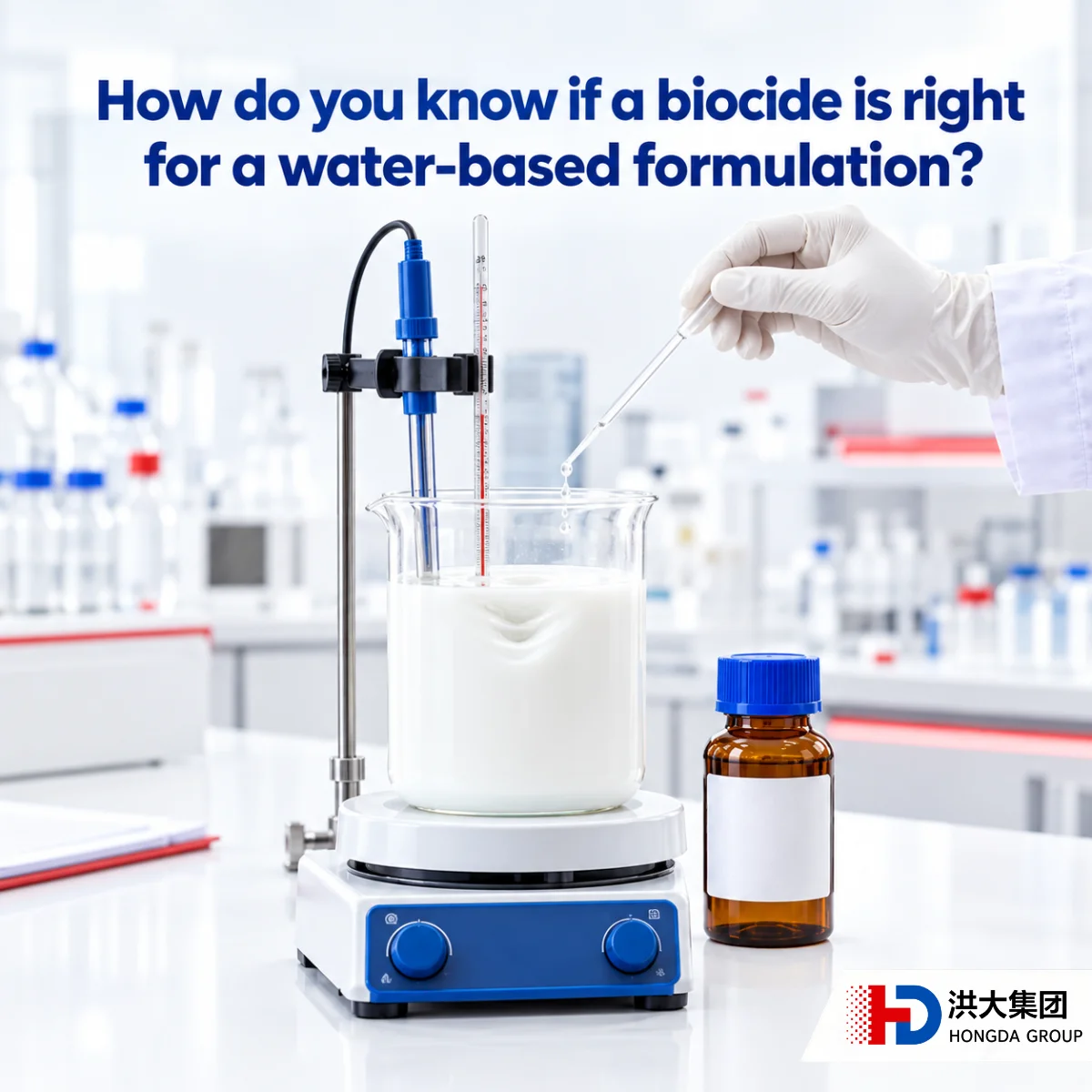
A water-based wood coatings plant wanted to reduce the ammonia smell in its workshop and in the finished product, so it replaced the ammonia in its formulation with an organic amine neutralizer, and the pH ended up somewhat higher than before. The preservative stayed the same CMIT/MIT system the plant had always used, at the same dosage. To save time in let-down, operators added it together with the other additives as soon as grinding finished, while the batch was still hot. Release testing at the plant was normal. A little over two months later, bulging cans began turning up in the distributor's warehouse. When opened, they gave off a sour, rotten smell and the paint had visibly thinned, and the plant had to recall those batches. Retesting of the retained samples showed that almost no isothiazolinone was left: the more alkaline system, the newly added amine and the high temperature at the time of addition had combined to use up the preservative early in storage. The same preservative had worked in the old formulation for years; once the formulation changed, its protection fell short.
How do you know if a biocide is right for a water-based formulation? To judge whether a biocide suits a water-based formulation, check whether the active ingredient stays stable at the product's pH and process temperature, whether formulation components consume it, whether its spectrum covers the microorganisms actually contaminating the product, and whether it meets the regulations of the target market. Then confirm the choice with residue testing after storage and a challenge test.
The figures on the data sheet come from someone else's formulation. A biocide's recommended dosage and applicable pH range are usually measured in a standard system. Your product is a mixture of emulsion, pigments and fillers, dispersants, thickeners, neutralizers and coalescents, and every one of these components can break down, consume or encapsulate the active ingredient. When we evaluate whether a biocide is right for a particular water-based formulation, we check four areas one by one: stability, compatibility, spectrum and compliance. If it fails any one of them, the protection period will be shorter no matter how much is added. Stability and compatibility are the most often overlooked, because their problems are completely invisible in release testing.
pH and addition temperature determine how long the active ingredient lasts. Alkaline hydrolysis: some actives break down faster at high pH. Most water-based coatings, colorant pastes and adhesives have a pH between neutral and slightly alkaline, and some formulations are adjusted even higher to keep the emulsion stable. CMIT/MIT acts fast and has a broad spectrum, but it gradually breaks down in high-pH systems; BIT is much more stable under alkaline conditions and suits products with a higher pH; bronopol breaks down faster in alkaline conditions and at higher temperatures, and its breakdown products include formaldehyde; DBNPA breaks down rapidly in alkaline water and is suitable only for shock treatment. When selecting a biocide, check it against the final pH of the finished product; values measured before pH adjustment tell you very little. Addition temperature and order: the same active, added differently, lasts a different length of time. A hot batch speeds up biocide breakdown, so the biocide is usually added after the material has cooled. The order of addition matters just as much: the biocide should not be charged at the same point and at the same time as concentrated amine neutralizers or reducing agents. Adjust the pH first and mix until uniform, then add the biocide and mix thoroughly so that no unprotected pockets remain in the product. Some biocide products can be diluted with water first to reduce losses caused by locally high concentrations. The wood coatings plant at the start of this article ran into trouble at both points at once: pH and addition temperature.
Other formulation components can quietly consume the biocide. Nucleophilic reactions: amines, sulfites and thiol-containing components. Isothiazolinones kill microorganisms by reacting with the thiol groups in their enzymes, and any formulation components that are also nucleophilic will react with them as well. Some amine neutralizers, reducing agents such as sulfites and bisulfites, and thiol-containing additives all gradually consume CMIT/MIT during storage. Release testing shows no change at all, yet a few weeks later the residual level has already dropped markedly. After switching to an amine neutralizer or introducing a new emulsion or additive, the biocide needs to be validated again. Partitioning and charge: the active gets hidden away or neutralized. Microorganisms live in the water phase, and a biocide has to stay in the water phase to work. More lipophilic actives such as OIT and DCOIT readily move into emulsion particles, the oil phase and surfactant micelles, which lowers their effective concentration in the water phase; they are better suited to dry-film mold protection. Charge can also cause conflicts: cationic biocides such as PHMB bind with anionic surfactants and anionic dispersants and lose their activity, and in severe cases they form a precipitate. Metal ions: discoloration on top of deactivation. Pyrithione salts form dark complexes with iron ions, which turn white and light-colored products gray or blue. Iron storage tanks, pipes and fillers with iron impurities can all introduce iron ions. When selecting a biocide for light-colored products, test color stability and preservative performance together.
If the spectrum does not match, the surviving microorganisms will take over the whole batch. Common contaminants in water-based products include Gram-negative bacteria such as Pseudomonas, as well as yeasts and molds. Each active has its own strengths: BIT works well against bacteria but does not fully cover some molds and yeasts; CMIT/MIT has a broad spectrum but is limited by pH and nucleophilic components. The gaps left by a single active are often filled within a few weeks by tolerant microbial populations. A more reliable approach is to first identify which microorganisms are actually present in the plant and in the product, and then choose a blend with complementary modes of action. The Vicente testing center at Ningbo Reayoung, part of Hongda Group, can perform microbial identification and colony counts to help determine which organisms need priority coverage.
A biocide that works technically still has to clear the regulations of the target market. Biocides are subject to registration and limits in every market. Some isothiazolinones are skin sensitizers, and above a certain concentration in the finished product they must be declared on the label; some markets and ecolabels set stricter limits on formaldehyde releasers and on total isothiazolinone content; some biocide products use solvents or glycols as carriers, and in low-VOC products the carrier has to be counted as well. A biocide that works smoothly in the domestic market may need to be replaced or used at a lower dosage when the product is exported to another market. Before selection, confirm the active's registration status, limits and labeling requirements in the target market, and only then move on to technical testing.
Make the final call with data from after storage. We recommend making lab samples that follow your actual process, adding the candidate biocide at the real pH, addition temperature and order of addition, and keeping a control group with no biocide. Store the samples at room temperature and under heat storage, and measure pH, viscosity, color and odor at regular intervals to judge whether the biocide and the system are compatible. After storage, run a preservative residue test to see how much active ingredient remains, and then use the stored samples for a microbial challenge test, ideally with an inoculum that includes organisms isolated from your plant. The Vicente testing center offers preservative and formaldehyde residue testing, inhibition zone testing and microbial challenge testing. Taken together, these three sets of data show whether the biocide can last through the full shelf life in your formulation.
The emulsion already contains a biocide. Does the finished product need more? Usually, yes. The biocide in the emulsion is designed for the emulsion's own storage. After dilution, pH adjustment and the addition of other components, both its effective concentration and its stability change in the finished product. The preservation system for the finished product has to be confirmed separately against the finished formulation, along with a check that it can coexist with the actives already in the emulsion. If there is a compatibility problem, can a higher dosage make up for it? A higher dosage only delays the problem. Breakdown and consumption continue, costs go up, sensitizers may exceed labeling limits, and some actives cause discoloration and odor at high dosages. Adjusting the choice of active, the addition temperature and the order of addition is more effective. After changing the emulsion or neutralizer, or adjusting the pH, does the original biocide need to be validated again? Yes. Changes in the emulsion, the neutralizer and the pH all alter the biocide's stability and how it partitions between phases; that is exactly where the problem at the wood coatings plant at the start of this article came from. At a minimum, repeat the residue testing after storage and the challenge test.
Hongda Group has manufactured and exported chemicals in Ningbo since 1992, selling to more than thirty countries. Our Vicentecide biocides and preservatives include more than forty actives with CAS numbers, and our brochure lists the structural formula, assay, packaging and storage conditions for each one. The formulated products cover the V and C series of in-can preservatives, the S series of dry-film fungicides and algicides, the VC series of personal care blends and the Ag series of silver-based antimicrobials. If you are adjusting the pH, neutralizer or emulsion of a water-based formulation, or your current preservative is starting to fail, tell us about your formulation system, final pH, addition process and target market, and we will screen suitable biocides with you and arrange validation. To learn more about working with us, visit hongda-chem.com, click "Become a strategic partner" and contact us via WhatsApp or WeChat.