
What Is a Custom Dye Color Matching Service, and How Is It Different From Standard Dyes?
Standard dyes are single shades supplied at a uniform strength and shade, and your own lab does the color matching. With a custom color matching service, the supplier designs the recipe from your color sample, delivers either the recipe or a premixed product, and takes responsibility for the color under the agreed light sources and color difference tolerance. The difference lies in who designs the recipe, who answers for the color, and which orders each approach suits.
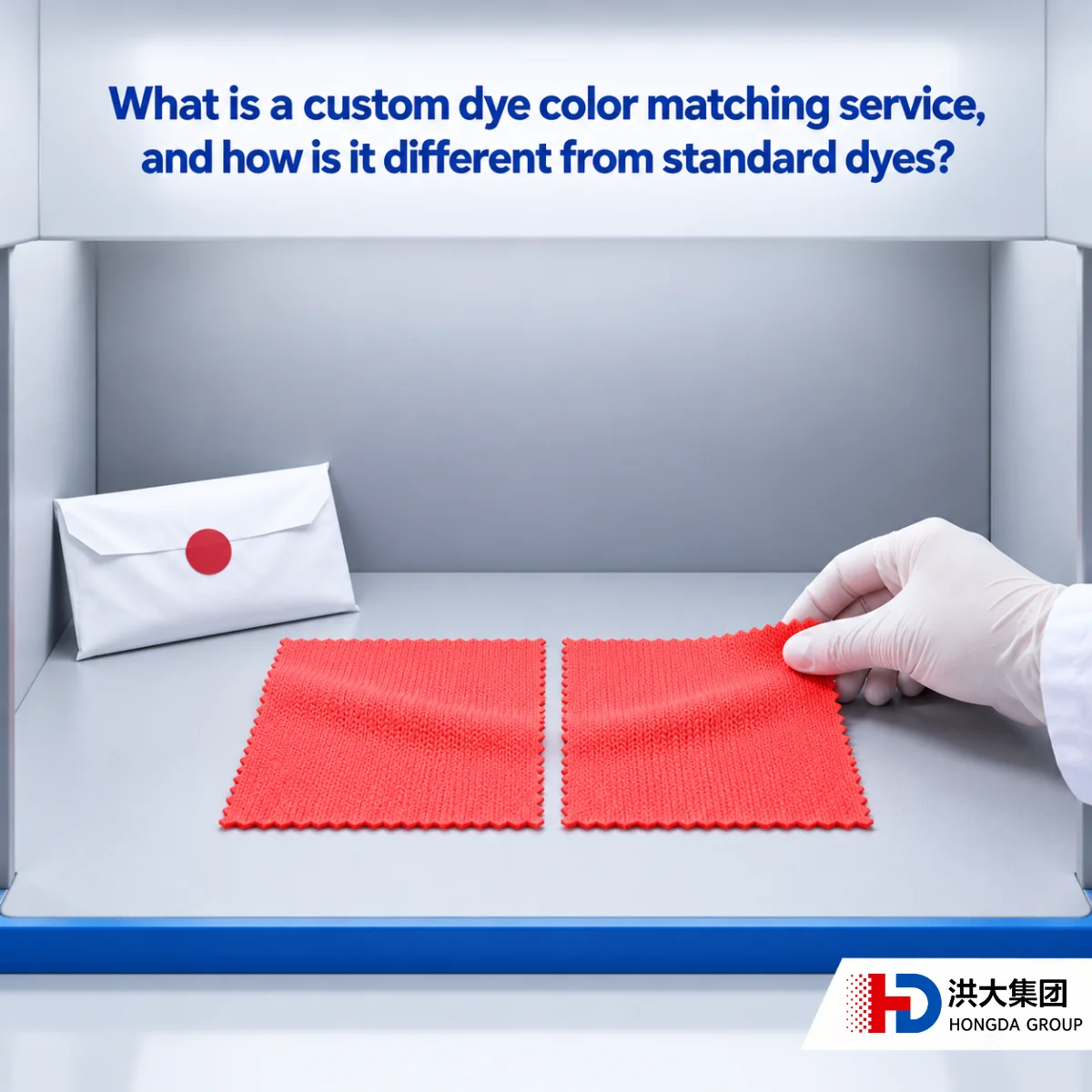
A fabric trader in South America received an order for sportswear fabric. The customer sent a fabric swatch and asked for the whole lot to be dyed to that color. The partner dyehouse matched it with three standard dyes it had in stock, and it took several rounds of lab dips to get reasonably close. The first bulk dye lot passed inspection under daylight in the light booth, but once the fabric reached the customer's stores, it looked clearly redder under the store lighting, and the customer returned part of it. When the repeat order came, the dyehouse used a new lot of dyes, followed the original recipe and got a color difference again; it had to start the lab dips over, and delivery kept slipping. When the trader reviewed what had happened, every problem traced back to color matching: who would do the matching, under which light sources, and who would answer for the color of each dye lot afterward. None of it had been put in writing when the order was placed.
What is a custom dye color matching service, and how is it different from standard dyes? Standard dyes are single shades supplied at a uniform strength and shade, and your own lab does the color matching. With a custom color matching service, the supplier designs the recipe from your color sample, delivers either the recipe or a premixed product, and takes responsibility for the color under the agreed light sources and color difference tolerance. The difference lies in who designs the recipe, who answers for the color, and which orders each approach suits.
From color sample to bulk production, every step needs an owner. Turning a color sample into a full lot of approved fabric takes color measurement, dye selection, recipe calculation, lab dips, approval, scale-up and a check on every dye lot. With standard dyes, the supplier is responsible for keeping the strength and shade of each dye consistent, and your lab and dyehouse handle every step after that. With custom color matching, the supplier takes over the recipe design and sometimes also premixes the dyes to the recipe before delivery. Many color disputes start because this division of work was left out of the contract. That dividing line decides who investigates a color difference and who pays for reprocessing.
Standard dyes: the supplier manages each dye, and the recipe stays in your hands. Standardization: every lot is adjusted to the same strength and shade. Before shipping, dye makers use sodium sulfate, dispersants and similar diluents to bring each lot of dye to their own standard strength and shade, which is why your recipe can carry over from lot to lot. That holds only within one maker's products: your recipe is written against one maker's standard, so if you switch to another maker's dye, you have to recalibrate strength and shade even when the Colour Index number is the same. Shade cards list the Colour Index number, depth of shade and each fastness rating shade by shade. Our textile dyes are organized into ranges by fiber: Dragonperse disperse dyes for polyester, divided by fastness requirement into the AC-E, UN-SE and CXF series; reactive and direct dyes for cotton; acid dyes for wool, silk and nylon; and cationic dyes for acrylic, each line with its own shade card. Your lab does the color matching. With standard dyes, the dyehouse lab uses a spectrophotometer and color matching software to choose the dye combination, calculate the recipe and approve the lab dips. The advantage is flexibility: one set of three primaries can produce hundreds or thousands of colors, the recipes belong to you, and you decide where to buy your dyes. This approach assumes an experienced colorist who knows how to combine dyes with similar exhaustion rates; cationic dyes for acrylic are combined by K value and F value, and our Dragonacrylic shade card lists both values for every shade. The initial recipe from the color matching software usually needs a few more rounds of lab dips to correct, and the colorist's experience decides how many; when the recipe goes into bulk, it also needs adjusting for the liquor ratio and heating curve of the dyeing machine.
Custom color matching: the supplier designs the recipe from your color sample. Two ways to deliver: the recipe, or a premixed product. In the first, the supplier's lab matches your color sample and gives you a recipe built from its own standard dyes, which you then buy and run. In the second, the supplier premixes several dyes or pigments to the recipe into a single product, one color per package, so the dyehouse weighs only one material and weighing errors drop sharply. Premixed products place higher demands on their components: the dyes must have close exhaustion rates and be mixed evenly, or the shade will shift as soon as the depth of shade or the holding time changes. Receiving the recipe suits mills with some lab capability that want to control their own purchasing; premixed products suit mills or distributors with limited lab dip and weighing capability and fairly fixed colors. Metamerism: match under the same light sources and on the same substrate as bulk production. When two colors match under one light source and separate under another, that is metamerism; it is how the fabric in the opening story gave itself away under the store lighting. Before custom matching, agree on the primary and secondary light sources, such as D65 daylight, TL84 store lighting and illuminant A, and match on the same fiber, fabric construction and pretreatment. If the customer sent a paper color card or a sample in another material, say so up front; the result on the actual substrate is what counts. A spectrophotometer can report a metamerism index under different light sources, and together with a visual check in the light booth, it catches the problem at the lab dip stage.
When terms are unclear, the cost shows up in bulk production and repeat orders. Color difference tolerance: write the pass criteria into the contract. The textile industry commonly uses the CMC(2:1) color difference formula; some companies use CIELAB color difference instead, combined with a visual check in the light booth. The contract should state which formula to use, the allowed color difference, the light sources for judging it and which sealed standard sample is the reference. When these terms are unclear, the same dye lot can pass in your eyes and fail in your customer's, and in the end the only way out is negotiation. For measurement, also agree on the observer angle (textile measurement usually uses the 10° observer), the number of fabric layers and the number of readings. Recipe ownership and repeat orders: can you dye the same color next time? With premixed products, repeat orders depend on the supplier producing to the original recipe, so ask the supplier to keep the recipe, the standard sample and the color measurement data for every lot on file, and keep retained samples yourself. If you received a recipe, repeat orders mean buying the same dyes; if you change dye sources, the recipe has to be validated again, which is a topic with its own article on this blog. Ask before you order who owns the recipe and how long it will be kept, and you will not have to start the lab dips over on a repeat order.
Which orders suit custom matching, and which suit standard dyes. Fixed colors produced over and over, brand-specified colors, special shades such as fluorescents, and buyers without a color matching lab are better served by custom matching; when the same color is produced at several mills, a single premixed product also helps keep it consistent. Mills with many colors, small lots, frequent color changes and an established lab get more flexibility from standard dyes. Many companies use both: custom matching for core colors, and their own matching for the rest. In our product line, fluorescent pigments can be matched to the color sample a customer sends, colors outside the shade card can be custom made, and water-based systems are possible as well. Before you choose, go through the past year's orders by color: which colors repeat and in what volume, and which were made only once. The answer is usually clear after that.
Custom color matching costs more per kilo than standard dyes. Is it worth it? Compare it with your total cost of doing the matching yourself: lab staff and instruments, the number of lab dip rounds, reprocessing and rework in bulk, and the losses from late delivery. For fixed colors with frequent repeat orders, custom matching is often simpler; for orders where colors keep changing, standard dyes are more flexible. Premixed products also remove the need to weigh several dyes, so there are fewer chances for mistakes in the dyehouse. We only have a fabric swatch. Can we ask the supplier to match it directly? Yes. Ideally, also provide the fiber and construction of the substrate, the dyeing or processing method, the primary and secondary light sources, the color difference tolerance and the fastness requirements. The more complete the information, the fewer lab dip rounds you need and the closer bulk production will be to the lab dip. Will a custom matched product give the same color from lot to lot? That depends on the standard sample and the inspection terms. The supplier should inspect every lot against the sealed standard sample, under the agreed light sources and color difference tolerance, and report the color measurement results on the certificate of analysis. When you sample incoming goods under the same conditions and keep retained samples, you have a basis for comparing one lot with the next.
Hongda Group has manufactured and exported textile chemicals and colorants in Ningbo since 1992, selling to more than thirty countries and working with more than five hundred distributors worldwide. Our disperse, reactive, direct, acid, cationic and vat dyes each have a complete shade card, fluorescent pigments can be custom made to a customer's color sample, and formula advice and comparison samples against your existing standard are part of the partnership from the first order. If you are looking for a stable color matching solution for fixed colors, or want to work out which approach suits your orders better, tell us your color sample, substrate, process, light sources and color difference requirements, and the relevant business unit will work out the solution with you. To learn more about working with us, visit hongda-chem.com, click "Become a strategic partner" and contact us via WhatsApp or WeChat.