
What Are Defoamers, and Why Are They Essential in Coatings Production?
Defoamers are additives that break down and suppress foam, eliminating the bubbles that coatings pick up during production, filling and application and preventing pinholes, craters and loss of gloss. They must stay suitably incompatible with the system, and the type, the addition stage and the dosage all have to be determined by testing.
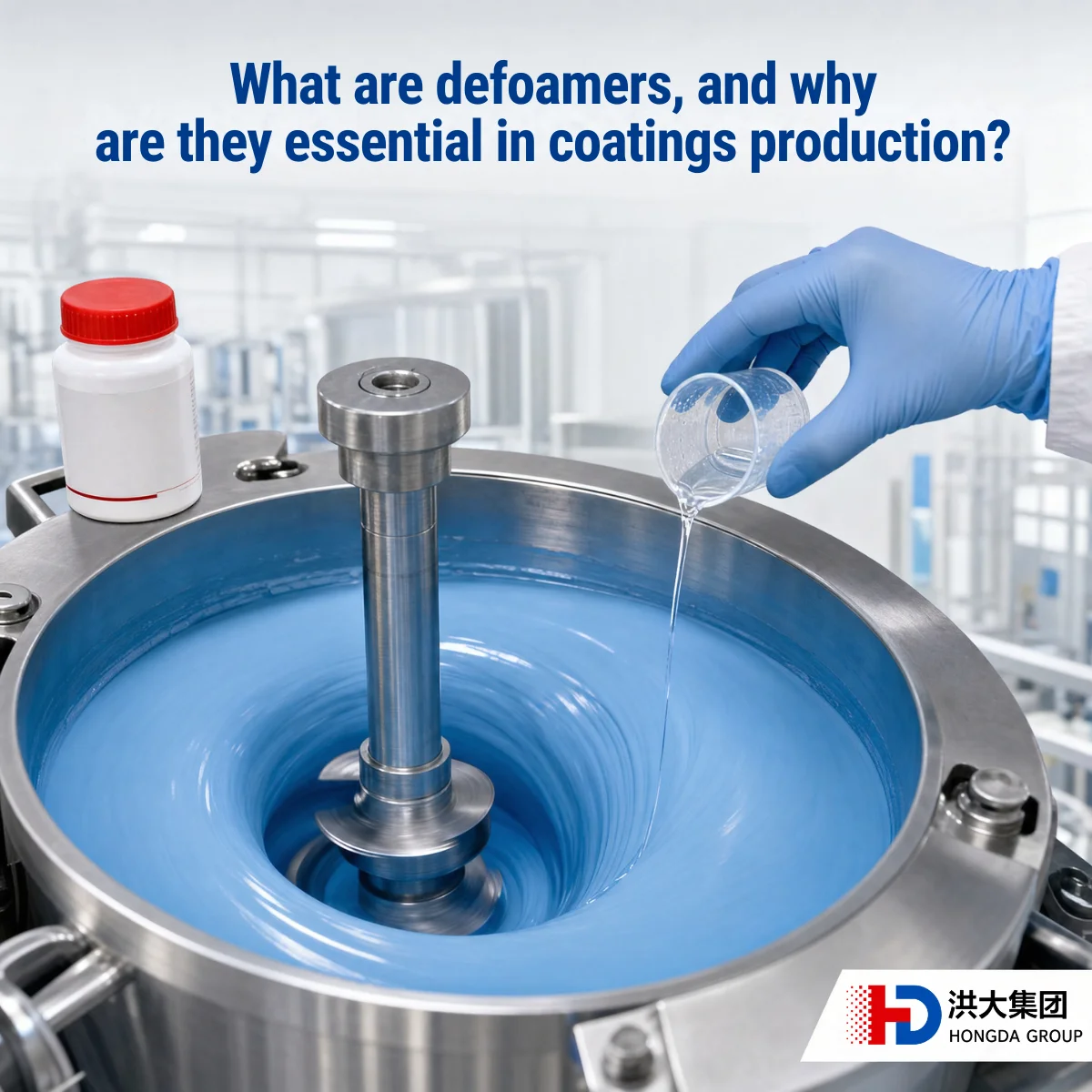
A coatings plant landed a large order for a waterborne industrial topcoat and scaled the formula straight from the small laboratory disperser to the high-speed dispersion tank on the shop floor. While the first batch was being dispersed, foam surged up to the rim of the tank, the operator had to slow down, and dispersion time stretched out; after filling, the liquid level in the pails kept sinking, and net content spot checks failed. Near the end of the letdown, the plant added a silicone defoamer it happened to have on hand, the foam went down and the order shipped on schedule. Two months later the complaints arrived: the sprayed finish was covered in pinholes and craters, the longer a pail had sat in stock the worse it foamed under the roller, and the customer demanded that the entire batch be replaced. The defoamer was the wrong type, it went in at the wrong stage, and after storage nobody had tested it again.
What are defoamers, and why are they essential in coatings production? A defoamer is an additive that breaks down and suppresses foam, eliminating the bubbles that form in coatings during production, filling and application and preventing pinholes, craters and loss of gloss. It has to remain suitably incompatible with the system, and its type, the stage at which it is added and its dosage all have to be set by testing.
Every step of waterborne coatings production brings air into the paint. Foam is the most common problem in coatings production, and also the one most easily underestimated. The vortex drawn by the impeller during high-speed dispersion, turbulence and impact during pumping and filling, and rollers, brushes and spray guns during application all carry air into the paint; as pigments and fillers are wetted, the air held in the gaps between particles is displaced too, forming large numbers of fine bubbles. Surfactants are what keep bubbles stable. Waterborne coatings contain emulsifiers, wetting and dispersing agents, thickeners and coalescents, and many of these components are surface active, lining up as a molecular film on the bubble surface. When a bubble wall is stretched thin, local surface tension rises, the surrounding liquid is pulled in to fill the gap and the wall regains its thickness, which is why foam can persist for a long time. Once a thickener raises viscosity, both the rise of bubbles and the drainage of the liquid film slow down, and the foam is even less likely to collapse on its own. Some polyether-modified silicone leveling agents also tend to stabilize foam, as we mentioned when we covered leveling agents. Macrofoam and microfoam are two different problems. Large bubbles floating on the surface of the liquid are called macrofoam and mainly affect production and filling; fine bubbles dispersed inside the paint are called microfoam, rise very slowly and end up trapped in the wet film after application. Once dry, microfoam stays in the film and is the main source of pinholes and loss of gloss.
The losses caused by foam stretch from the plant floor all the way to the customer's site. In production, dispersion efficiency drops and filling becomes inaccurate. When the dispersion tank is full of foam, the bubbles cushion the impeller's shear, the target fineness is hard to reach, dispersion time has to be extended, and part of the tank's capacity is taken up by foam. Aerated paint has a lower density, so filling by volume leaves the net content short, while filling by weight tends to overflow the pail; once the foam subsides the level drops, and the customer opens a pail that is not full. During application and film formation, the result is pinholes, craters and weaker protection. If bubbles introduced during application do not escape before the wet film dries, they leave pinholes, volcano-shaped pits and a rough surface; microbubbles trapped in the film lower gloss and distinctness of image. In anticorrosive coatings, bubbles and pinholes shorten the path water, oxygen and corrosive media have to travel to reach the substrate, and protective service life shrinks with it. These defects only show up after delivery, and the cost of rework and claims far exceeds the cost of dealing with foam at the production stage.
The way a defoamer makes bubbles burst can be summed up in three steps: entry, spreading and film rupture. First, low surface tension droplets enter the bubble wall. The defoamer is dispersed in the paint as fine droplets whose surface tension is lower than the paint's and which do not mix with it. When a droplet touches a bubble wall, it enters the liquid film and spreads quickly, pushing aside the previously stable layer of surfactant molecules and carrying liquid away from the film; the bubble wall thins at that spot, loses its ability to heal itself and finally bursts. Many defoamers also contain hydrophobic silica particles, which speed up rupture by bridging across both sides of the liquid film. Depending on the stage at which they act, defoamers perform three functions: defoaming, foam suppression and deaeration, which respectively break down existing foam, stop foam from stabilizing and release the microbubbles inside the paint. Waterborne systems focus more on the first two, while high viscosity, solvent-free and UV curing systems have a greater need for deaeration. Before selecting a product, first work out which kind of foam you need to deal with.
The stronger the defoaming power, the higher the risk of craters. A defoamer only works if it stays somewhat incompatible with the system, and once that incompatibility goes too far, it creates defects in the film. If compatibility is too good, the defoamer dissolves into the paint and loses its defoaming ability; if compatibility is too poor, the droplets are too large and unevenly distributed, the film shows craters, fisheyes and haze, and recoat adhesion suffers as well. The core of selection is finding the balance point between defoaming efficiency and film appearance. Defoamers fall into three families: mineral oil, silicone and polymer. Mineral oil defoamers are low in cost with moderate defoaming power and are commonly used in flat and semi-gloss waterborne architectural coatings; in high-gloss systems they tend to cause loss of gloss. Silicone defoamers have very low surface tension, work at low dosages and act fast, but when the grade or dosage is wrong, they are the most likely to cause craters and recoat problems, which is exactly what happened to the coatings plant at the start. Polymer defoamers include non-silicone polymers such as acrylic copolymers and vinyl ethers; they have little effect on appearance and recoatability, deaerate well and are commonly used in high-gloss paints, clear coats and multi-coat systems. Our Chemtech defoamers, the 30xx series and 3100, cover modified polysiloxanes as well as non-silicone polymers such as acrylic copolymers and vinyl ethers, with active content ranging from 3% to 100%, and every grade states the systems it suits. Waterborne, solventborne and UV systems behave differently. Waterborne systems contain many surfactants and stabilize foam strongly, so they demand a long-lasting defoamer. Solventborne systems do not foam easily in themselves; their problems mostly come from high solids formulations and microfoam introduced by spraying, so deaeration matters more. UV curing systems have high viscosity and cure fast, leaving microbubbles almost no time to escape, so they need grades with high deaeration efficiency that do not interfere with cure. The same grade moved into a different system may perform completely differently.
Added at the wrong stage or left untested after storage, even a good defoamer stops working. Split the addition between the grind stage and the letdown stage. The usual practice is to add it in two portions: one part at the grind stage to control foam during high-speed dispersion, and the rest at the letdown stage, dispersed evenly at low to medium speed, to keep defoaming capacity in reserve for filling, storage and application. Shear is intense at the grind stage, so the defoamer is easily over-emulsified, the droplets become too fine and the effect weakens; with insufficient mixing at the letdown stage, the droplets stay too large and cause craters. The coatings plant at the start added its defoamer as a last-minute fix near the end of the letdown, which put it right on the crater-prone side. Defoamers lose strength in storage, so test both fresh samples and heat-aged samples. Over time, the defoamer in the paint gets emulsified or adsorbed by surfactants, or it may float up and separate, and this is often why a coating that was fine when it left the plant foams heavily once it reaches the customer. Evaluation therefore calls for three tests. Density method: measure the density of the paint immediately after high-speed stirring and compare it with an unstirred sample; the smaller the difference, the less air has been introduced. Foam height method: shake or stir the paint in a graduated cylinder and record the foam height and the time it takes to collapse. Application panels: roll, spray or brush panels using the customer's actual application method, check for pinholes, craters, fisheyes and gloss, and check recoat adhesion with a cross-hatch test. Run all three tests once on fresh samples and once on heat-aged samples, increasing the dosage step by step from low to high to find the range where defoaming meets the target and appearance is unaffected.
The foam on the surface is gone, so why does the film still have pinholes? Once the surface foam disappears, the macrofoam is under control, but microfoam may remain inside the paint, get trapped in the wet film after application and form pinholes as it dries. In that case, check the deaeration ability of the defoamer, and look at formulation viscosity, wet film thickness and application method as well. What happens if too much defoamer is added? Excess defoamer causes craters, fisheyes and haze, high-gloss systems lose gloss, and silicone types can also affect recoat adhesion. Set the dosage through step-by-step testing to find the lowest dosage that meets the defoaming requirement. After switching to a different emulsion or dispersant, can you keep using the same defoamer? It has to be validated again. Emulsifiers and wetting and dispersing agents determine how strongly the system stabilizes foam and also affect the defoamer's compatibility, so once a raw material changes, the old balance point may shift.
Hongda Group has manufactured and exported chemicals in Ningbo since 1992, selling to more than thirty countries. Our Chemtech coating additives cover dispersants, leveling agents, defoamers, rheology modifiers, substrate wetting agents and film property modifiers for waterborne, solventborne and UV systems. If your production line is struggling with foaming, pinholes or craters, tell us about your system, your application method and the grades you use now, and we will work out the defoamer type, addition stage and trial dosage together. To learn more about working with us, visit hongda-chem.com and click "Become a strategic partner".