
What Is the Difference Between Disperse Dyes and Reactive Dyes?
Disperse and reactive dyes color completely different fibers, and choosing the wrong type leads to uneven shade or fast fading, especially on polyester-cotton blend fabrics.
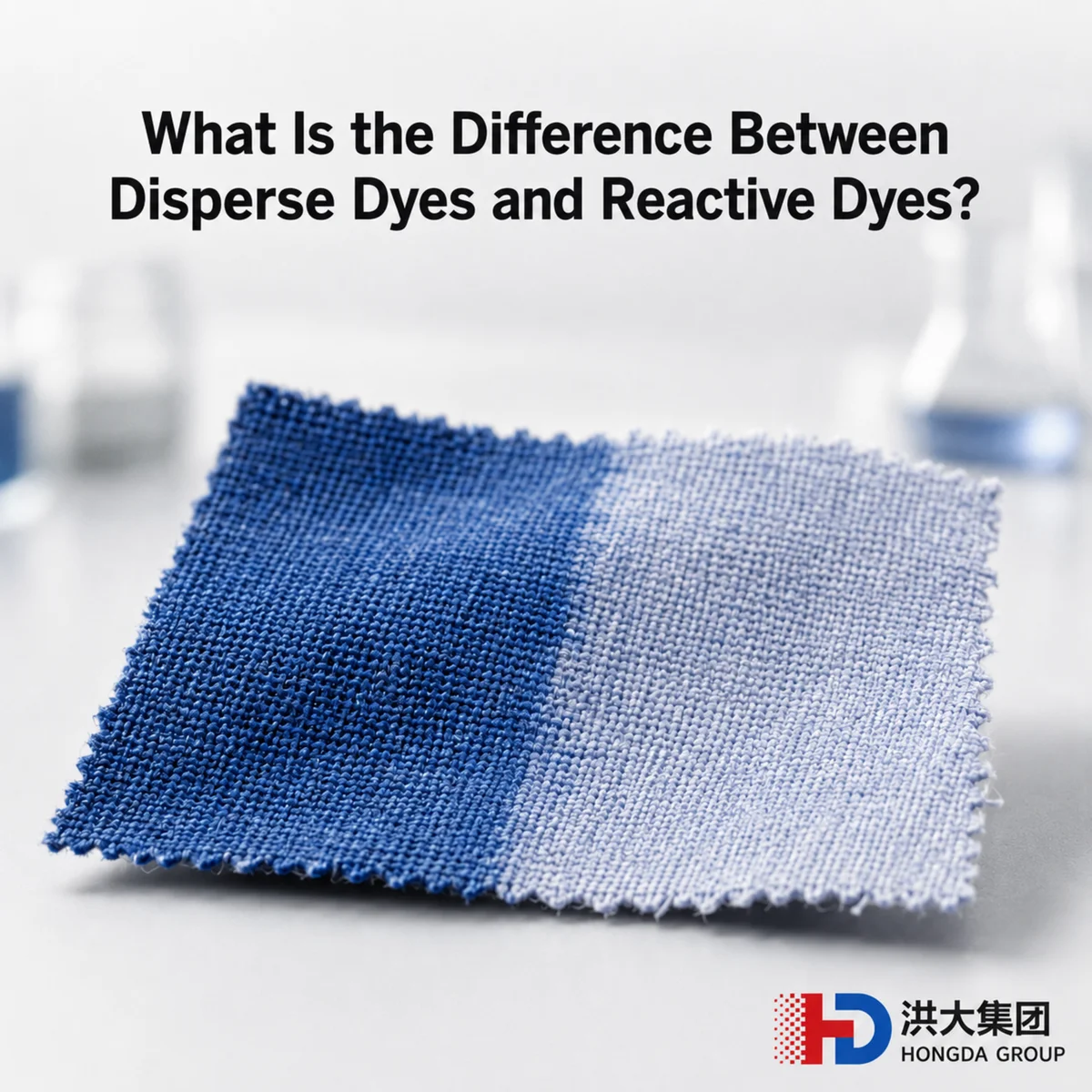
A batch of polyester-cotton blend fabric reached inspection, and the customer rejected it on the spot: the shade was uneven, the polyester portion looked washed out while the cotton portion had taken the color too deeply. After repeatedly checking the formulation, the dyeing and finishing mill traced the problem back to its root: the wrong dye type had been chosen from the start. Disperse dyes and reactive dyes are both called "dyes," but they color completely different fibers. Get the mixing sequence or temperature control wrong, and the entire batch may need reworking, with delivery times and costs recalculated from scratch.
What is the difference between disperse dyes and reactive dyes? Disperse dyes are formulated specifically for hydrophobic synthetic fibers such as polyester, while reactive dyes bond to cellulosic fibers such as cotton and viscose through a chemical bond. Choose the wrong dye type, and the color either fails to take at all or fades quickly.
Polyester fiber is strongly hydrophobic, and disperse dyes themselves are almost insoluble in water. They first need to be broken down into fine, evenly dispersed particles with the help of a dispersing agent, then carried into the fiber under high temperature (or, at atmospheric pressure, with a carrier agent added) so that the dye molecules penetrate the amorphous regions inside the fiber and bond with it through physical embedding. This process does not involve forming a chemical bond, so the fineness and dispersion stability of the dye particles directly determine whether the final color comes out even.
Reactive dyes are highly water-soluble, and their molecular structure carries a reactive group (a vinyl sulfone type or a triazine type, for example) that reacts under alkaline conditions with the hydroxyl groups on the surface of cellulosic fibers like cotton and viscose, forming a stable covalent bond. This chemical bonding is the fundamental reason reactive dyes generally have good wash fastness. Polyester fiber has no hydroxyl sites available for this reaction on its surface, so a reactive dye can only sit on top of the fiber; it washes off in large amounts after just a few launderings, showing up as patchy color or fading.
Polyester-cotton blends usually need disperse and reactive dyes working together to complete dyeing: the polyester portion is dyed first under high temperature, then the process shifts to alkaline conditions to dye the cotton portion, what's commonly called the two-bath method. Some processes use auxiliary combinations to compress both steps into a single dye bath instead, known as the one-bath method. Whichever process is used, poor control of the dyeing sequence and temperature curve easily causes disperse dye to stain the cotton fibers, or reactive dye to take up unevenly, ultimately showing up as mismatched shade depth between the polyester and cotton portions of the blend.
Disperse dye is not recommended for use directly on 100% cotton fabric: it is almost insoluble in water and has no chemical group that can bond with cotton fiber, so the color it produces has very poor adhesion and fades sharply after just a light wash. Pure cotton fabric should use reactive dyes or vat dyes instead. When both polyester and cotton need to be colored, disperse dye is typically used for the polyester portion and reactive dye for the cotton portion, working together to complete the overall dyeing. If only one of the two fibers needs color (to create a heather or cross-dyed effect, for instance), a single dye can be used while the other fiber stays essentially in its natural color. Reactive dyes bond with cellulosic fibers through a covalent bond, and this chemical bond is stable and hard to break down with everyday washing, while disperse dyes rely mainly on physical embedding inside the fiber; they can also achieve good fastness on polyester, but if applied to a fiber they are not suited for, fastness drops noticeably because there is no chemical bonding involved.