
Principle and Application Fields of Fluorescent Whitening Agents
Fluorescent whitening agents whiten by an optical principle, without damaging the article. This article covers how they work, why they depend on ultraviolet light, the fields where they are used and their safety.
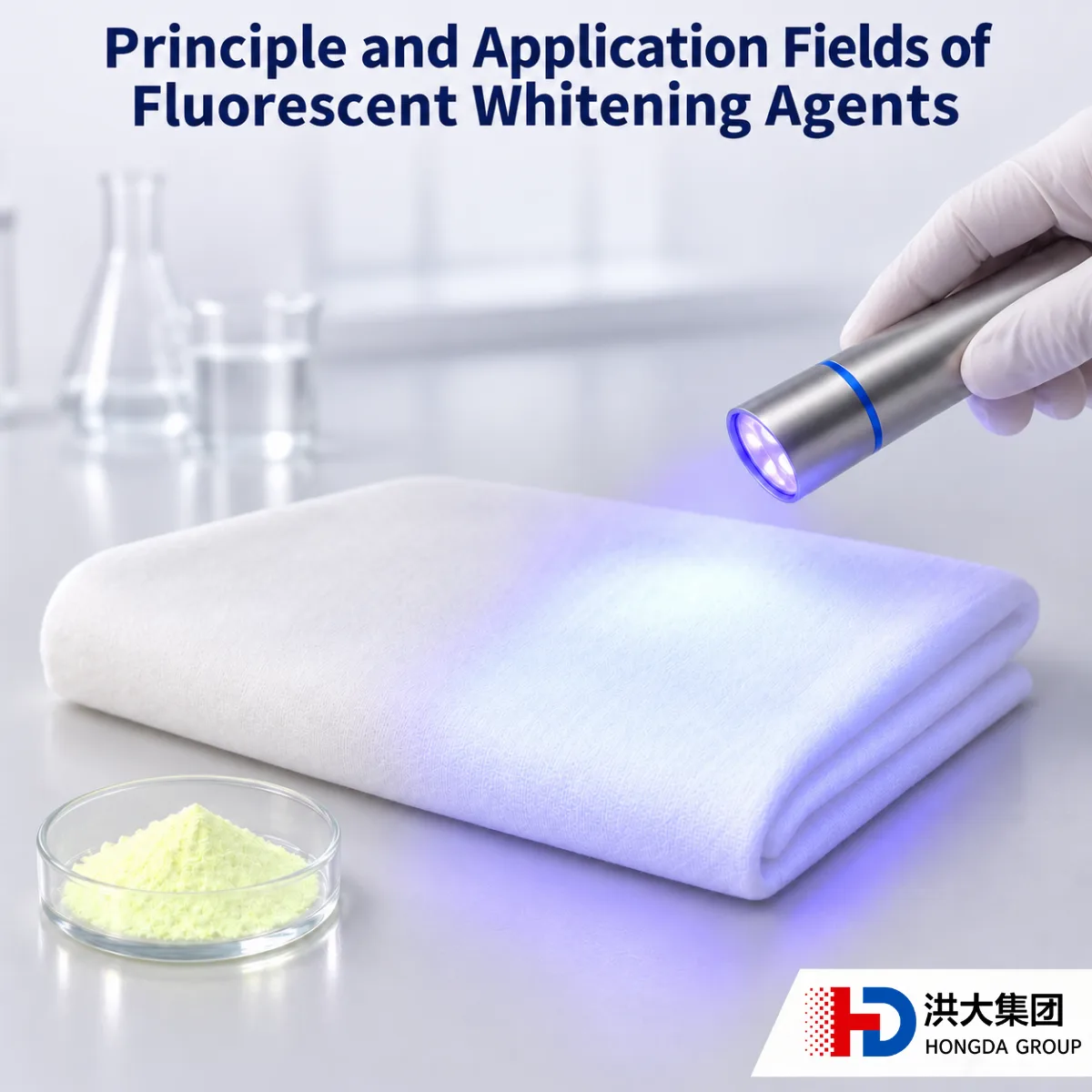
The whitening effect of fluorescent whitening agents is achieved through an optical principle. By optical color complementation and brightening they improve the visual impression without damaging the article being whitened; for example, they do not reduce the fiber strength of textiles. Their light-compensating effect cannot be matched by methods such as bleaching or bluing, and for substrates that already have a certain whiteness they are currently the most commonly used and most efficient means of whitening.
However, the fluorescence of fluorescent whitening agents comes from ultraviolet light, so the higher the ultraviolet content of the illuminating light, the more marked the whitening effect. If the light source has little or no ultraviolet light, the whitening effect is very limited.
In Which Fields Are Fluorescent Whitening Agents Used?
Fluorescent whitening agents have been in use for more than 75 years. At first they were used only in textiles; today they are widely used in papermaking, detergents, plastics, coatings, inks, leather, anti-counterfeiting, laser detection and many other industries, extending even to biomedicine. Their range of application is still expanding and is closely related to our production and daily life.

Are Fluorescent Whitening Agents Safe?
Since fluorescent whitening agents are so closely related to our lives, are they safe? For a long time people have misunderstood them, believing deep down that they are harmful to the human body. In fact, before being used in a product, fluorescent whitening agents must pass strict inspection at every level. For example, CBS-X, a fluorescent whitening agent common in detergents, was formally used in laundry liquid only after being certified by authoritative institutions at home and abroad. Moreover, the amount of fluorescent whitening agent added is extremely low, only a few parts per ten thousand, and its effect is basically negligible.