
How Does High-Temperature, High-Pressure Dyeing Get Dye into Polyester Fibers?
High-temperature, high-pressure dyeing relies on heat to open up polyester fiber. Pressure keeps the water liquid above 100°C. Once the temperature exceeds the fiber's glass transition temperature, the molecular chains in the amorphous regions start to move and gaps open inside the fiber that dye molecules can pass through; dye molecules dissolved in the dyebath adsorb onto the fiber surface and then diffuse into the fiber, and after cooling the chains tighten and the dye is fixed inside.
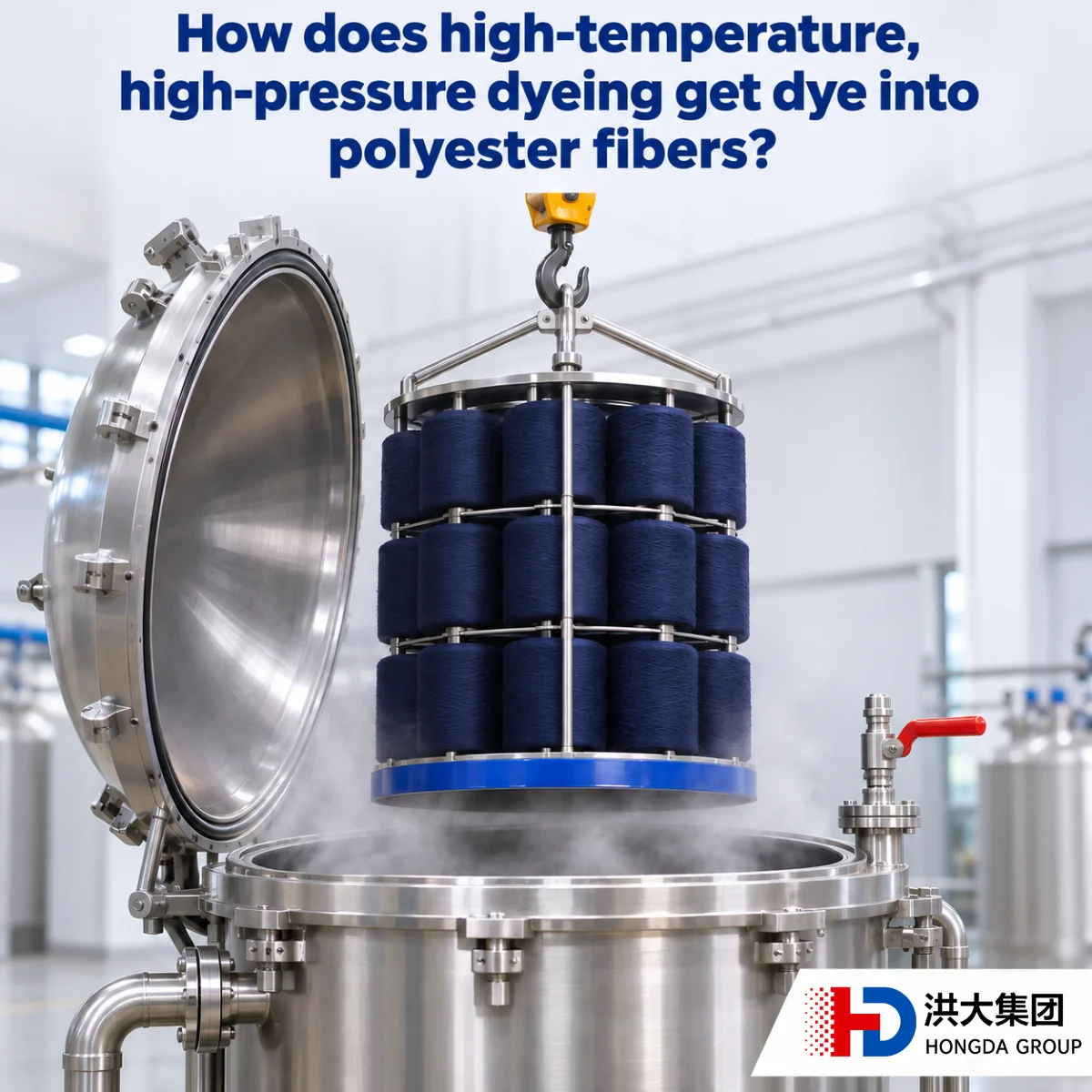
A package yarn dyehouse took a rush order for navy polyester yarn that its customer would weave into sportswear fabric. To meet the delivery date, the shop floor shortened the holding time at top temperature, and the actual temperature in the machine also ran a notch below the process card. When the yarn came out of the machine, the color looked deep enough, but after reduction clearing it turned noticeably lighter, and the inner and outer layers of the packages differed in depth of shade. Once the customer had woven the fabric, horizontal streaks appeared, rubbing fastness and washing fastness both failed, and the whole lot was returned. Stripping and redyeing took another week, and the dyehouse paid for the yarn and the weaving costs. Under the microscope, fiber cross-sections made the problem obvious: the dye was concentrated in the outer layer of the fiber and had not diffused into its interior. The result of high-temperature, high-pressure dyeing depends on whether the dye gets enough temperature and time at the top of the cycle to complete its whole journey into the fiber.
How Does High-Temperature, High-Pressure Dyeing Get Dye into Polyester Fibers? High-temperature, high-pressure dyeing relies on heat to open up polyester fiber. Pressure keeps the water liquid above 100°C. Once the temperature exceeds the fiber's glass transition temperature, the molecular chains in the amorphous regions start to move and gaps open inside the fiber that dye molecules can pass through; dye molecules dissolved in the dyebath adsorb onto the fiber surface and then diffuse into the fiber, and after cooling the chains tighten and the dye is fixed inside.
A ceiling of 100°C holds back polyester dyeing at atmospheric pressure. An open dyeing machine at atmospheric pressure can heat the dyebath only to the boiling point of water, around 100°C. At that temperature, polyester's molecular chains have already started to move, but the gaps are still small and the dye diffuses very slowly. Light shades can just about be dyed; medium and dark shades either fail to build depth or take a very long time, and the fastness falls short as well. Dyeing polyester at atmospheric pressure requires a carrier to swell the fiber, and the carrier's odor and residues add a new treatment burden. The idea behind the high-temperature, high-pressure method is simple: seal the dyeing machine. In a closed vessel, the steam pressure generated as the water heats up raises the boiling point, so the dyebath stays liquid above 100°C and keeps circulating. The pressure in the machine rises with the temperature, and its role is to keep the dyebath liquid at high temperature. What drives the dye into the fiber is temperature. To judge whether a batch of yarn was dyed well, look at two records, temperature and time.
Dye has to complete four steps to travel from the dyebath into the fiber. Disperse dye enters polyester fiber in four consecutive steps. If any one of them falls behind, the result for the whole batch suffers. Step one, particles dissolve into single molecules. Disperse dye is suspended in the dyebath as fine particles, and the fiber can absorb only the small fraction dissolved in water as single molecules. Disperse dyes have very low solubility in water, and it rises markedly with temperature. As the temperature climbs, more particles dissolve, the concentration of single molecules available to the fiber goes up, and the particles act as a reservoir that keeps topping it up. The dispersant keeps the particles fine and uniform, so dissolution can continue steadily. Step two, dye molecules reach the fiber surface and adsorb onto it. Dissolved dye molecules have to be carried by the dyebath to the vicinity of the fiber, pass through the slow-moving liquid film at the fiber surface and then adsorb onto the fiber. This step depends on liquor circulation: in package dyeing, the main pump forces the dyebath through the yarn layers, while overflow and airflow dyeing rely on the relative movement of dyebath and fabric. If packages are wound unevenly, or fabric tangles in the machine, the dyebath cannot flow through, less dye adsorbs in that spot, and that is where shade differences between inner and outer layers and uneven color on the fabric come from. Step three, diffusion from the fiber surface into the interior. This is the slowest of the four steps, and it sets the pace of the whole dyeing process. Dye molecules adsorbed on the surface have to move, little by little, toward the center of the fiber along the gaps between the molecular chains in its amorphous regions. The more gaps there are and the larger they are, the faster the diffusion. The crystalline regions of the fiber are tightly packed and the dye cannot enter them, so coloring takes place only in the amorphous regions. This is the step where the yarn in the opening story went wrong: the temperature was too low, the time too short, and the dye stayed in the outer layer of the fiber. Step four, after cooling the dye is locked inside the fiber. When dyeing ends and the bath cools, the temperature falls back below the glass transition temperature, the molecular chains freeze again, the gaps close, and the dye that entered the fiber is enclosed inside. Dye and fiber are held together by intermolecular forces, and the deeper the dye goes, the harder it is for later washing and rubbing to pull it out. Dye that stays in the outer layer is washed off during reduction clearing, and the color turns lighter.
Why temperature can open gaps in polyester fiber. Polyester is a polymer whose molecular chains are coiled and entangled in the amorphous regions. Below the glass transition temperature, the chain segments are frozen and can only vibrate in place, and there are no channels inside the fiber for dye to pass through. Once the temperature rises above the glass transition temperature, the segments gain enough energy to rotate and move, and momentary gaps keep opening between them, which textile chemistry calls free volume. The higher the temperature, the more vigorously the segments move, the larger the free volume, and the faster dye molecules enter the gaps and move toward the inside of the fiber. Diffusion speeds up quickly as the temperature rises, and a few more degrees at the top of the cycle make the dye diffuse noticeably faster. This also explains why temperature control at the top of the cycle has the greatest effect on depth of shade: with the same holding time, a temperature that runs a notch low means the dye travels a notch less deep. The condition of the fiber itself also changes the size of this door. Polyester goes through different temperatures and tensions during spinning, drawing and heat setting, so its crystallinity and the structure of its amorphous regions differ, and under the same dyeing conditions the rate and depth of dye uptake differ too. Mixing fiber from different lots, or greige fabric with inconsistent presetting conditions, in one batch produces streaks and shade differences, and these problems have to be traced back to the fiber and the pretreatment.
Migration during the holding phase evens out the color. At high temperature, the dye moving into and out of the fiber is in dynamic equilibrium: some dye keeps diffusing toward the inside of the fiber, while some dye that has already adsorbed desorbs from the fiber surface, returns to the dyebath and is taken up by fiber elsewhere. This process is called migration. Areas that took up more dye during heating give some of it up, areas that took up less keep absorbing, and the color gradually evens out. The holding time gives migration the chance to happen, and it also gives the dye time to diffuse to the center of the fiber. When the holding time is cut short, the dye stays in the outer layer and migration has no time to even out shade differences, so both problems appear at once.
The heat that opens the fiber also magnifies three risks in the dyebath. Dispersion stability gets worse at high temperature. As the temperature rises, the dispersant protects the dye particles less effectively, and the particles collide and aggregate more easily. Aggregated particles dissolve more slowly and can also be filtered out by the yarn layers or the fabric surface, forming color specks and spots. The dyes and dispersants used in high-temperature, high-pressure dyeing need to be tested for dispersion stability at the actual dyeing temperature. An alkaline dyebath hydrolyzes some dyes. The molecular structure of some disperse dyes hydrolyzes under hot alkaline conditions, which shifts the shade and makes the color lighter. High-temperature, high-pressure dyeing is carried out in a weakly acidic dyebath; alkali left over from pretreatment has to be washed out completely, and the pH of the dyebath has to be set before heating and kept stable. Oligomers in the fiber come out at high temperature. Polyester forms a small amount of oligomers during polymerization, and they are distributed inside the fiber. High temperature opens gaps in the fiber, and the oligomers migrate along these same channels to the fiber surface and into the dyebath; after cooling they crystallize and deposit on the yarn, the fabric surface and the inner walls of the dyeing machine, showing up as white powder, white spots and a harsh hand. Dye entering the fiber and oligomers leaving it use the same channels, so the higher the dyeing temperature and the longer the hold, the more oligomers come out. Ways to control them include using an oligomer dispersant, draining the bath at a higher temperature and cleaning the dyeing machine regularly.
Does raising the pressure in the dyeing machine make dye enter the fiber faster? Pressure rises with temperature, and its role is to keep the dyebath liquid at high temperature. The speed at which dye enters the fiber is set by temperature and time, and raising the pressure on its own does nothing for dye uptake. A dyeing machine is a pressure vessel, and pressure beyond the equipment's rated range is also a safety risk, so operate it according to the equipment specifications and inspect the safety valve and seals regularly. Why did our dyed yarn turn much lighter after reduction clearing? Reduction clearing removes the dye that stayed on the fiber surface without entering the fiber. If the color is noticeably lighter after clearing, a substantial part of the dye never completed diffusion, and the causes lie at the top of the cycle: the temperature ran low, the holding time was too short, or poor liquor circulation kept the dye from getting in at some spots. Checking the actual temperature records against the process card does more to solve the problem than adding more dye. Why does microfiber polyester come out lighter with the same recipe? Microfiber filaments are finer, so the same weight of fiber has a much larger specific surface area; dye adsorbs and diffuses faster, and reaching the same depth takes more dye. Faster uptake also means the material is more likely to dye unevenly during heating, and the requirements for sublimation and washing fastness are higher. Microfiber polyester needs its own lab dips; neither the recipe nor the process can be copied straight from regular polyester.
Hongda Group has manufactured and exported textile chemicals and colorants in Ningbo since 1992, selling to more than thirty countries and working with more than five hundred distributors worldwide. Our disperse dyes come in type E, SE and S ranges with a complete shade card that lists the fastness and suitable processes for every shade, and every lot ships with a test report and a sealed standard sample. If your high-temperature, high-pressure dyeing comes out too light, shows shade differences between inner and outer layers or loses color after clearing, tell us your fiber specifications, equipment type, process curve and target color, and our textile dyes business unit will advise you on both dye selection and process and arrange samples. To learn more about working with us, visit hongda-chem.com, click "Become a strategic partner" and contact us via WhatsApp or WeChat.