
What Do Leveling Agents Do in Coatings and Inks?
Leveling agents are additives that adjust the surface tension of the wet film, letting coatings and inks flow out smooth before they dry, eliminating orange peel, brush marks, craters and floating, and raising gloss. They are used in very small amounts, and choosing the right type and dosage directly decides film appearance and recoat performance.
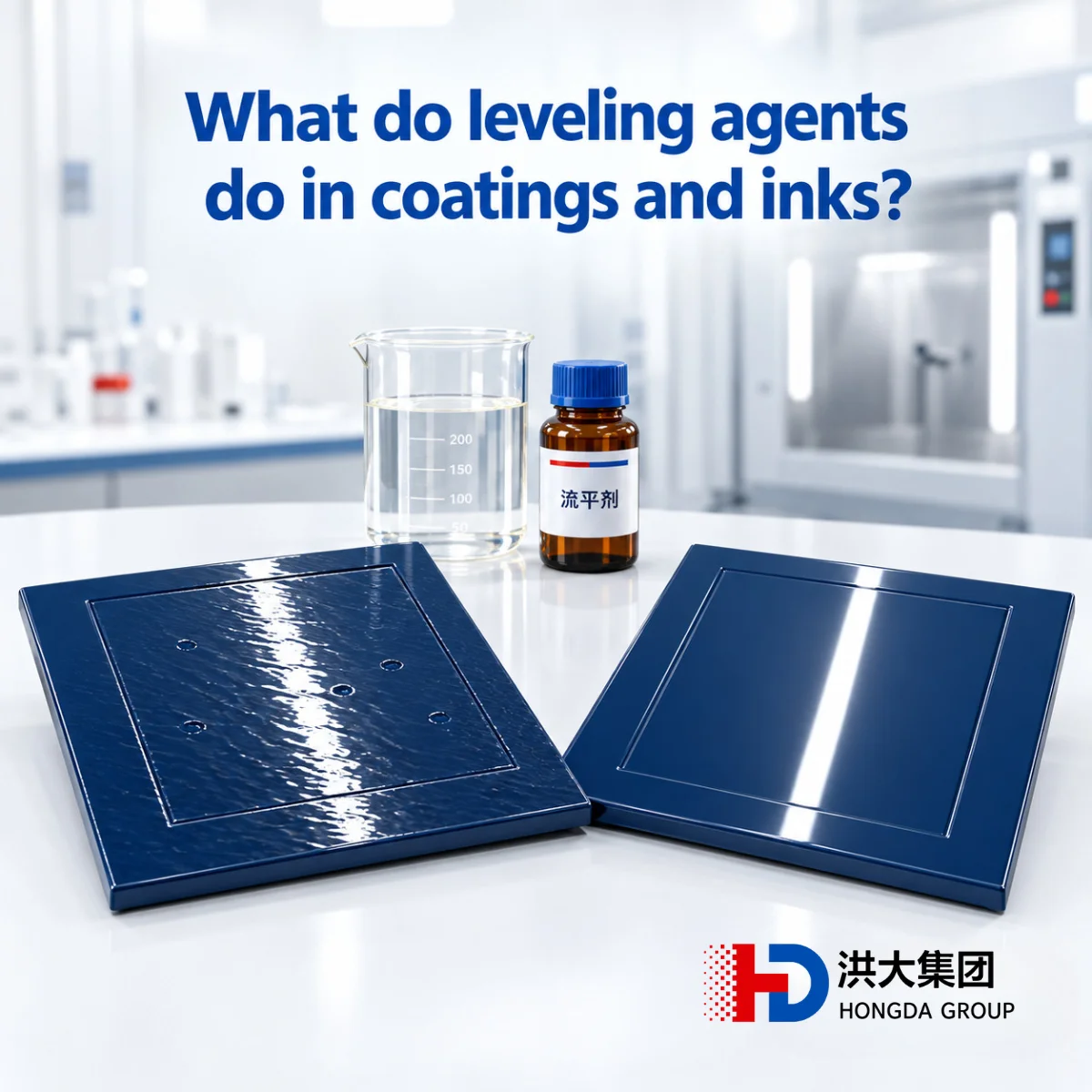
A coatings manufacturer supplied a high-gloss polyurethane clear topcoat to a furniture plant. The furniture plant installed a new spray line and switched to a new batch of primer, and in the first week a large number of cabinet door panels went back for rework: the finish rippled like orange peel, with round craters in places, obvious at a glance under the lights. The coatings maker's technician went to the site and added leveling agent to the topcoat, and the orange peel and craters eased. Two weeks later a new complaint arrived: topcoat sprayed after sanding repairs did not adhere properly, and cross-hatch tests peeled off in sheets. The same additive left the surface uneven when too little was used and caused intercoat adhesion problems when too much was used, and at the first selection, nobody had looked closely at its type or dosage.
What do leveling agents do in coatings and inks? A leveling agent is an additive that adjusts the surface tension of the wet film so that coatings and inks flow out level before they dry into a film, eliminating orange peel, brush marks, craters and floating while raising gloss. It is used in very small amounts, and whether the type and dosage are chosen correctly directly decides the appearance of the film and its recoat performance.
Once a coating or ink is applied to the substrate, the wet film surface is full of irregularities: spraying leaves the relief of atomized droplets, roller and brush application leave lines, and printing leaves dot and doctor blade marks. Before drying, the wet film has to flatten these irregularities through its own flow. That window is short: solvent is evaporating, viscosity is rising and crosslinking is under way, and as soon as the wet film loses its ability to flow, the surface shape at that moment is locked in. The driving force of leveling is surface tension. Surface tension always pulls a liquid surface toward the smallest area, which means toward flatness; the force resisting leveling is viscosity. How fast a film levels depends on surface tension, viscosity, wet film thickness and the spacing of the irregularities: the thicker the film, the lower the viscosity and the finer the irregularities, the faster it levels. Widely spaced, gentle undulations are the hardest to remove, and orange peel belongs to this group. Surface tension gradients are the source of craters and floating. More important than the level of surface tension is whether it is uniform across the whole wet film. As solvent evaporates, the solvent ratio and temperature change from point to point on the surface, differences in surface tension appear, and liquid is pulled from areas of low surface tension toward areas of high surface tension. This flow sets up Bénard cells in the wet film that carry pigments apart, showing up as floating and flooding. Oil, dust and silicone oil landing on the wet film, as well as contamination spots on the substrate, all have very low surface tension, so the surrounding coating is pulled away from them, leaving a crater sunk in the middle.
Here there is an apparent contradiction: surface tension is what drives leveling, yet many leveling agents lower surface tension. The answer lies in uniformity. A leveling agent migrates to the surface of the wet film and forms an evenly distributed molecular layer that flattens out local differences in surface tension, while bringing overall surface tension below that of the substrate and any contaminants so the wet film can spread out. Once surface tension evens out, the force driving Bénard cells weakens and floating and flooding decrease; contamination spots lose their ability to pull the surrounding coating away, and cratering drops with them. Leveling agents also help with substrate wetting, preventing crawling and bare spots. A coating or ink can spread over a substrate only when its surface tension is lower than the substrate's surface energy. Plastic films, oily metal and low surface energy primers are the most prone to crawling, bare spots and pinholes, and a leveling agent that lowers surface tension helps the wet film cover the substrate fully.
Choose the wrong type or add too much, and the problem shows up in the next process step. The first is loss of recoat adhesion and intercoat cratering. Silicone leveling agents concentrate at the surface of the dry film, and alongside a slippery feel and better scratch and blocking resistance, they also lower surface energy, so the next coat or a repair coat struggles to wet and adhere, leading to intercoat delamination and even new craters in the recoat layer. Furniture finishing, automotive refinish and industrial coating lines that require sanding and repair are the most sensitive to this, and it is exactly the problem the coatings maker at the start ran into. The second concerns ink overprinting, lamination and hot stamping. In inks, excess silicone leveling agent interferes with post-press converting: the next ink color fails to spread over the previous one, the peel strength of laminated film drops, the printed surface becomes too slippery, and adhesives and hot stamping foil bond poorly. Flexible packaging inks in particular need tight control over the dosage of these additives.
By chemical composition, common leveling agents fall into two main classes: modified polysiloxanes and acrylic copolymers. Our Chemtech leveling agents, the 10xx series and 6710, cover both. Modified polysiloxanes lower surface tension and even it out. They lower surface tension strongly and bring clear improvements in cratering, substrate wetting and surface slip. The modifying group determines their character: polyether-modified grades lower surface tension the most and suit systems that need strong wetting, though some grades tend to stabilize foam and make bubbles hard to release; polyester-modified grades have better heat resistance and suit baking enamels; aralkyl-modified grades have good resin compatibility and relatively little effect on recoatability. Grades carrying reactive groups can be built into the film during cure, reducing migration to the surface. Acrylic copolymers offer a silicone-free leveling solution. Acrylic leveling agents have less effect on surface tension and work mainly by forming an even layer at the surface, improving long-wave leveling and eliminating orange peel while also helping deaeration. Being silicone-free, they have very little effect on recoatability and intercoat adhesion, which suits systems that need multiple coats and sanding repairs. Their weak points are weaker crater control than silicones and haze when compatibility with the resin is poor.
Select by system and set the dosage by testing. Selection starts with the system: waterborne, solventborne or UV curing, which resin, whether application is by spray, roller, curtain coating or printing, and whether recoating, sanding repair, lamination or hot stamping will follow. Then look at the problem to be solved, whether orange peel, craters, floating or poor substrate wetting, since different problems call for different types. Dosage has to be set by testing. Prepare panels on the actual substrate with the actual application method, check orange peel, craters and floating, and measure gloss and distinctness of image; check recoat adhesion with a cross-hatch test; for inks, also test overprinting, lamination and peel strength. Start at a low dosage and increase step by step to find the range where appearance meets the target and recoatability is unaffected. Leveling agents have their limits too: problems rooted in solvent balance or resin selection lie beyond their reach. Our Chemtech coating additives documentation lists the chemical composition, solids content, silicone content, reactive groups and suitable systems for every grade, along with the common benchmark grades each one corresponds to; it also includes selection guides for wood coatings, automotive and refinish coatings, industrial baking and plastic coatings, and floor coatings.
What is the difference between a leveling agent and a wetting and dispersing agent? They act in different places. A wetting and dispersing agent acts on the pigment surface, helping the pigment get wetted, broken apart and kept stable; a leveling agent acts at the interface between the wet film and the air, adjusting surface tension and improving appearance; a substrate wetting agent acts at the interface between the wet film and the substrate and partly overlaps with the leveling agent. A formulation usually needs all three. If craters have already appeared, will adding more leveling agent solve them? First find the source of the craters. If they come from oil or silicone contamination on the substrate, in the compressed air or in the environment, improving cleaning and filtration is more effective than adding more additive; if they come from incompatible components in the formulation, the formulation needs adjusting. Once the cause is clear, a moderate addition of silicone leveling agent can ease the problem, and recoat adhesion should be tested at the same time so the problem stays out of the next process step. Can waterborne and solventborne coatings use the same leveling agent? Some grades work in both, while most are suited to only one of the two. Waterborne systems have higher surface tension and place higher demands on substrate wetting. When selecting, check the suitable systems stated for each grade and test in the actual formulation.
Hongda Group has manufactured and exported chemicals in Ningbo since 1992, selling to more than thirty countries. Our Chemtech coating additives cover dispersants, leveling agents, defoamers, rheology modifiers, substrate wetting agents and film property modifiers for waterborne, solventborne and UV systems. If your coatings or inks are running into orange peel, craters, floating or recoat adhesion problems, tell us about your system, your application method and the grades you use now, and we will work out the leveling agent type and trial dosage together. To learn more about working with us, visit hongda-chem.com and click "Become a strategic partner".