
What Common Quality Problems Are Caused by Poor Dispersion of Industrial Pigments?
Poor pigment dispersion shows up directly as low tinting strength, batch-to-batch color variation, flooding and floating, specks and seeds, loss of gloss and coarsening or settling in storage. The root of these problems lies not in the color itself but in whether the pigment particles were properly wetted, deagglomerated and stabilized.
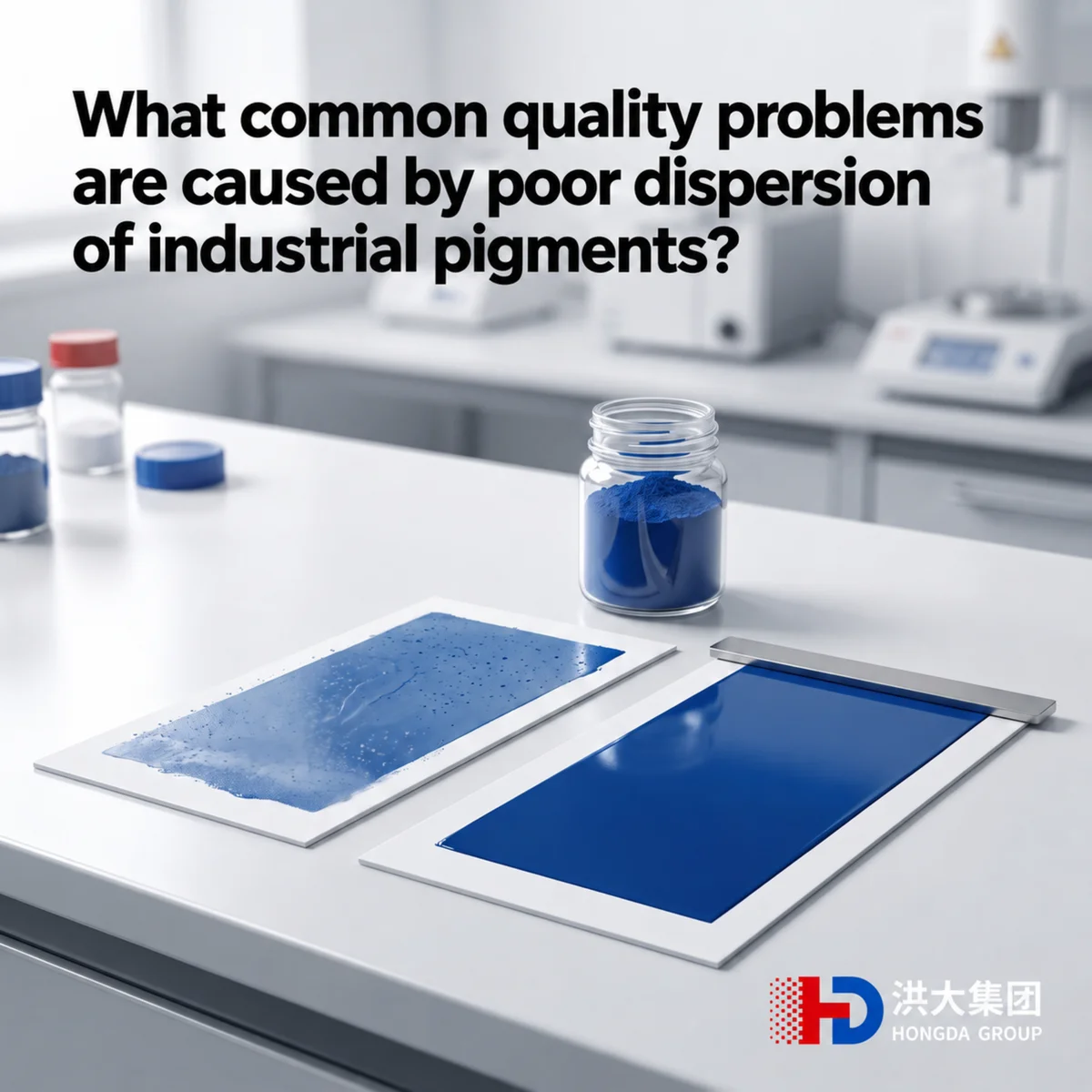
A batch of blue industrial topcoat passed every laboratory test at bench scale, but once scaled up to the production tank its tinting strength came in low, and only by adding more pigment could the color be pulled to standard, with the cost over budget. Sprayed onto the customer's equipment, the surface showed mottling and fine seeds, and the gloss sat a step below the sample panel. The customer rejected the batch and asked for the cause. Formulation, pigment lot and process parameters were all unchanged; what changed was dispersion. The bench trial ran on a laboratory bead mill, and the dispersion equipment and time on the production line never actually broke the pigment apart.
What common quality problems are caused by poor dispersion of industrial pigments? Poor dispersion shows up directly as low tinting strength, batch-to-batch color variation, flooding and floating, specks and seeds, loss of gloss, and coarsening or settling after storage. The root of these problems is not the color itself but whether the pigment particles were fully wetted, deagglomerated and kept stable.
Pigment leaves the factory as a powder, and the particles in that powder are not single primary particles but agglomerates and aggregates made of many primary particles clustered together. Dispersion means opening those clusters in the resin or solvent system, distributing the primary particles as evenly as possible, and keeping them from clustering again during later storage and use. Color, hiding power, transparency, gloss and storage stability all depend on how well that step is done. Three stages are indispensable: wetting replaces the air adsorbed on the pigment surface with the liquid medium and lets it penetrate the clusters; deagglomeration uses the mechanical force of the milling equipment to break the clusters into smaller particles; stabilization lets the wetting and dispersing agent adsorb onto the newly exposed pigment surface and prevent reagglomeration through charge repulsion or steric hindrance. If any one of the three falls short, the effort of the other two is undone in storage or at application. Particle size decides tinting strength, transparency and gloss: for the same weight of pigment, the finer the dispersion, the greater the total particle surface, the more complete the absorption and scattering of light, and the higher the tinting strength, while transparent pigments also become more transparent. Coarse dispersion not only lowers strength but leaves coarse particles standing out of the film surface, scattering light and pulling gloss down. That is why the same formulation gives entirely different color and appearance depending on the state of dispersion.
The following problems recur in coatings, inks and plastics coloring; they look like different defects, but traced to the root they are often the same one. Insufficient tinting strength and batch color variation: an under-dispersed pigment delivers only part of its coloring capacity, so the pigment loading in the formula looks sufficient while the color never reaches standard; adding pigment brings the color closer at higher cost, and the next batch, dispersed slightly differently, shifts again, so many batch differences are differences in degree of dispersion rather than in the pigment itself. Flooding and floating: in coatings, when two or more pigments differ in dispersion state, particle size and density, they separate after application, one floating to the surface and the other sinking, and the film shows uneven color patterns or an overall shade that does not match the can; this is the classic dispersion problem of multi-pigment coatings.
Seeds, specks and pinholes: clusters that were never opened are visible particles in the paint or ink film, especially on thin films and high-gloss products, and coarse particles can also scratch the coating during application or interfere with film formation as it dries, leaving pits and pinholes that the customer sees at a glance and that often lead straight to rejection. Loss of gloss and haze: the coarser the particles, the rougher the film surface, the more scattered the reflection and the lower the gloss, so high-gloss industrial topcoats and inks have the strictest fineness requirements, and even slightly poor dispersion visibly drops gloss and distinctness of image, leaving the color looking hazy and dull. Specks and streaks in plastics: in plastics coloring, poor dispersion appears as specks, streaks and uneven depth of shade on the part surface, and in film and fiber the clusters block screens or break filaments and disrupt production; because shear and residence time in plastics processing are limited, the inherent dispersibility of the pigment and the quality of the masterbatch are decisive here. Coarsening and settling in storage: a pigment that was opened during dispersion but not properly stabilized reclusters during storage, showing as coarser fineness, rising viscosity and color change, in severe cases forming hard sediment; the customer opens the can to find a product different from the one that shipped, and the root of that complaint is again dispersion, only delayed.
Three groups of causes lie behind poor dispersion. The pigment itself: the finer the primary particles and the higher the surface energy, the tighter the clusters they form and the harder they are to disperse; surface treatment changes the compatibility of pigment and medium, so a well-treated grade wets quickly and disperses with little effort, while a pigment with high oil absorption needs more wetting and dispersing agent and longer milling, and choosing a grade that matches the system and disperses easily is the way to reduce problems at the source. The formulation: the wetting and dispersing agent must match the pigment surface and the resin system, since organic and inorganic pigments need different dispersants and waterborne and solventborne systems differ too; too little fails to stabilize, too much harms film properties, and dispersant dosage is normally calculated from the pigment's specific surface area rather than by simple weight ratio. The process: laboratory bead mills and production dispersers deliver different shear, so a passing bench trial does not guarantee a passing scale-up; insufficient milling time, excessive temperature that deactivates resin or dispersant, and dumping the pigment in at once so the premix is uneven all keep dispersion from meeting the target, which is why the dispersion process has to be revalidated at scale rather than copied from bench parameters.
Four checks are commonly used to judge whether dispersion is adequate: measuring fineness with a grind gauge to see whether coarse particles remain; comparing tinting strength by reducing sample and standard at the same ratio and judging depth of shade; making draw-downs and rub-outs to observe flooding, floating and gloss; and running storage stability tests to watch fineness, viscosity and color after a period of standing. Only when all four pass is dispersion truly in place. Many dispersion problems can be avoided at the selection stage: prefer surface-treated, easily dispersible pigment grades; for lines with limited dispersion equipment, consider predispersed pigment preparations or pastes and hand the dispersion step to a specialist stage; and require the supplier to guarantee consistent particle size and surface properties from lot to lot, because the dispersion process is set to the pigment's characteristics and when the pigment changes the process has to change with it. When Hongda supplies pigments to coatings, ink and plastics customers, we recommend grades according to the customer's system and dispersion equipment and provide dispersibility data, so the dispersion process can be set right the first time.
What is the most common reason dispersion passes at bench scale and fails at production scale? Differences in equipment shear and milling time: laboratory bead mills usually disperse more efficiently than production equipment, so copying bench parameters directly leads to under-dispersion, and fineness, tinting strength and storage stability should all be revalidated at scale. Does raising the dispersant dosage cure poor dispersion? Only when the dispersant was genuinely short: excess dispersant hurts the water resistance and adhesion of the film and cannot make up for insufficient equipment shear or an inherently hard-to-disperse pigment, so the cause should be found first and the dosage adjusted afterwards. Are predispersed pigment preparations and pastes worth using? Very much so for lines with limited dispersion capability, tight batch consistency requirements or many color variants: dispersion is already completed by a specialist stage, the line only has to mix, and tinting strength and batch consistency are better assured, at a unit price above pigment powder.
Hongda Group manufactures organic pigments, inorganic pigments and titanium dioxide in Ningbo and exports to more than thirty countries, with products widely used in coatings, inks and plastics coloring. If your line is struggling with color variation, mottling or seeds, tell us about your system and your dispersion equipment and we will look together at where pigment selection and the dispersion process can still be improved. To learn more about working with us, visit hongda-chem.com and click "Become a strategic partner".