
Why Does a Reliable Supplier Matter More Than Price When You Buy Chemicals in Bulk?
When you buy in bulk, the unit price is only part of the total cost. Batch consistency, on-time delivery, and proper documentation and technical support determine whether formulas need adjusting, whether production lines stop and whether you keep your customers, and together these costs often exceed the savings on price.
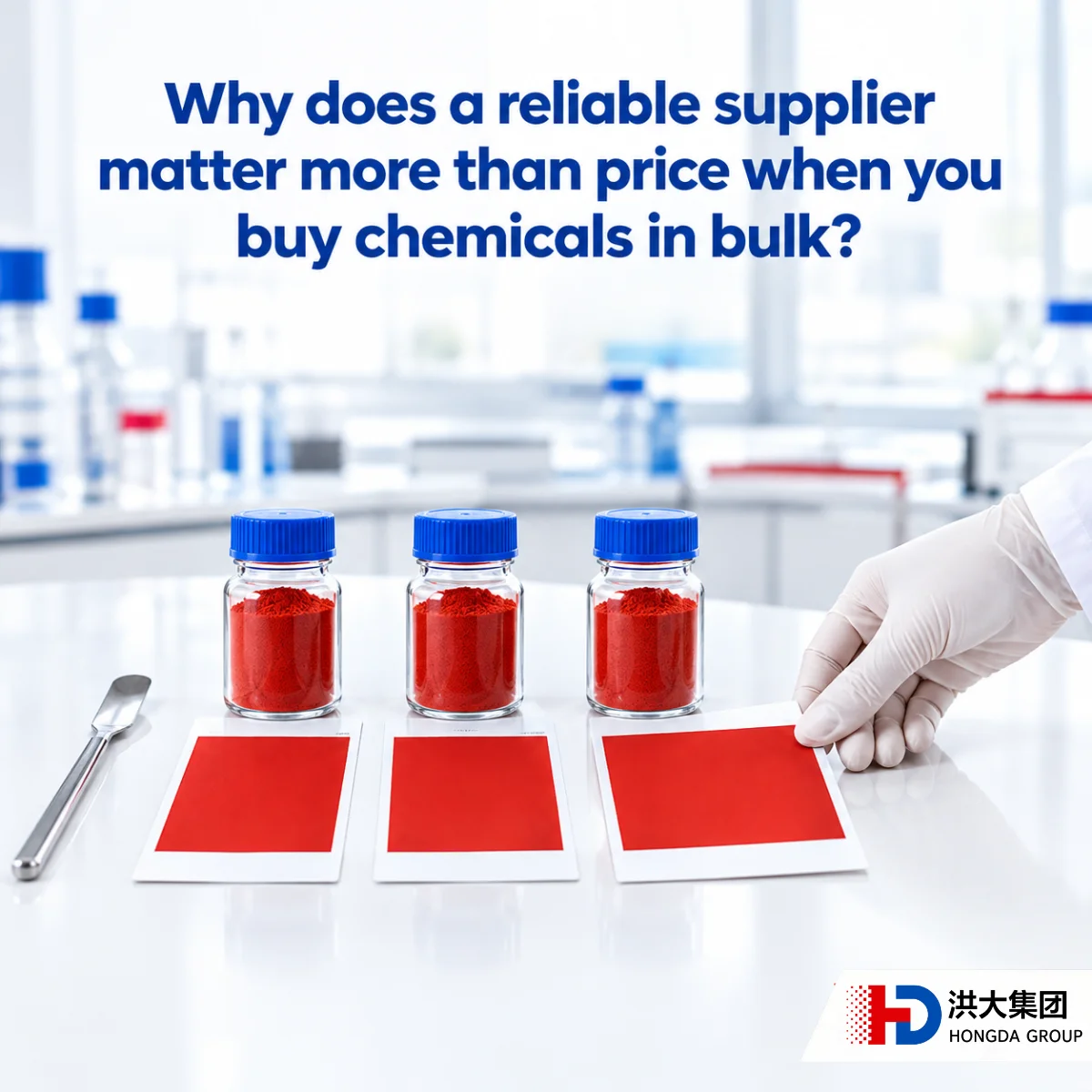
A coatings raw materials distributor in the Middle East had supplied titanium dioxide and organic pigments to more than a dozen local coatings plants for years. To bring the unit price down, its purchasing team moved half of the annual volume to a trader with a lower quote. The first two containers were fine. In the third, the pigment's tinting strength was clearly low, and several coatings plants had to recalibrate their tinting formulas; one of them had already produced an entire batch of paint and had to rework it, and the complaint calls kept coming to the distributor. Then the peak season arrived, and the trader announced a delay of more than a month, saying the upstream plant had been shut down for corrective action. The distributor's stock ran out quickly, it had to airfreight an emergency shipment, and several customers turned to other sources; the largest one signed a full-year contract with someone else. When the numbers were tallied at year end, the savings on price fell far short of the cost of rework, airfreight and lost orders.
Why does a reliable supplier matter more than price when you buy chemicals in bulk? When you buy in bulk, the unit price is only part of the total cost. Batch consistency, on-time delivery, and proper documentation and technical support determine whether formulas need adjusting, whether production lines stop and whether you keep your customers, and together these costs often exceed the savings on price.
The money saved on unit price often gets paid back in later containers. When comparing quotes, everyone looks at the price per ton first. What actually lands on your books is the full cost of each ton of raw material from order to finished, on-spec product: incoming inspection, formula adjustments, rework and scrap, extra stock held against shortages, emergency freight, and the business lost when customers leave. Price is usually negotiated once a year, while these costs occur every month. Buying in bulk multiplies them: a batch deviation in one container affects dozens of batches of your downstream products, and one late delivery affects supply for an entire peak season. When we run the numbers with partners in different countries, we put these items next to the unit price, and the conclusion is often the opposite of what the quote alone suggested.
Batch variation: the cost hides in your plant and in your customers' plants. Shade and tinting strength drift: every batch means adjusting the formula again. When a pigment's tinting strength is low, coatings and masterbatch plants have to add more pigment or recalibrate their tinting formulas; when a dye's shade shifts, dyehouses have to redye or match the shade again. We wrote a separate article on why the same dye lot can produce different shades between dyeing batches. Each adjustment looks small on its own, yet it repeats with every delivery and takes up lab and production time. Distributors have it even harder, because every adjustment happens in the customer's plant, and what the customer remembers in the end is that your product is inconsistent. Changing sources: behind the same grade, there may be a different factory. Some traders buy from several plants at once and ship from whichever is cheapest. The grade and the Colour Index number stay the same, while crystal form, surface treatment, particle size distribution and impurity levels may differ: the crystal form and surface treatment of titanium dioxide determine how it performs in coatings, plastics and inks, and the particle state of an organic pigment affects dispersion and shade. Asking before you order which plant makes the product and whether that will change is worth more than negotiating a few more points off the price. Our dyes, pigments, additives and functional chemicals are managed by the group's divisions, some product lines are made by group companies such as Ningbo Reayoung and Dalian Amines Chemical, and each division answers for every batch it ships.
Supply disruption: one shutdown can cost you a customer. Upstream shutdowns and tight capacity travel down the supply chain. Chemical production is constrained by environmental rules, safety rules and raw material supply at the same time. Environmental inspections have shut down some dye and intermediate plants in the past, and downstream buyers faced shortages and price increases for a time; when raw materials are tight, plants with limited capacity give priority to orders from long-term customers. For a trader, switching sources is routine; for you, switching sources means new samples and new validation, and in peak season you cannot afford the wait. A supplier with stable capacity and planned production schedules shows its value most at moments like these. Safety stock and emergency freight: unreliable supply ties up your cash. When lead times are uncertain, the only thing you can do is carry more stock. The higher the safety stock, the more cash and warehouse space it ties up, and pigments and additives stored too long risk caking, absorbing moisture and passing their shelf life; when stock still falls short, airfreight and rush orders eat up the savings on unit price. Reliable supply lets you order against your demand forecast and keep inventory at a reasonable level. We offer our partners volume pricing and consolidated shipping, and we schedule production against your forecast.
Documents, compliance and technical support are often missing from a low quote. Documents and compliance: customs delays are a cost too. Every chemical shipment needs a technical data sheet, certificate of analysis, safety data sheet, HS code and origin documents that all match; we went through the technical documents you need to check when importing dyes and pigments, item by item, in another article. When documents are incomplete, the goods sit in port for several extra weeks, and you bear the demurrage and your customers' wait. Hongda exports to more than thirty countries and works with more than five hundred distributors worldwide, so we have most likely already handled the documentation your market requires. Technical answers: when a formula has a problem, who responds? In bulk supply, an occasional deviation is hard to rule out entirely; what matters is whether someone can investigate the cause and give you an answer when it happens. Our samples, technical information and technical answers come directly from the team that makes the product, and formulation advice, sample matching against your current standard and follow-up after delivery are part of working with us from the first order. A supplier that only quotes prices can usually offer nothing more than a return or replacement when a complaint comes in; the cause stays unclear, and the same problem comes back.
To judge whether a supplier is reliable, look at the data and the years. Batch data and production source. Before the first order, ask the supplier for certificates of analysis from the last several batches of the same grade and look at how much the key values vary; request samples from different batches and compare them side by side with your standard sample; and ask which plant makes the product, what its capacity is, and whether you will be notified in advance of changes in raw materials or process. When the trial order arrives, test against the certificate of analysis and keep retained samples as a reference for later batches. The less the key values vary from batch to batch, the less your formula needs to change with each batch. When your annual volume is large, also confirm whether the supplier can reserve capacity against your forecast, and write lead times and change notification into the contract. How long and how the partnership has worked. A long track record is more reliable than any promise. In 1995, our president Yuan Junjie flew to Brazil with a case of samples and began working with Transcor, then a young pigment company; that partnership continues today, and Transcor is now one of the three largest pigment suppliers in Brazil. Today Hongda has strategic partners handling local distribution in sixteen countries, and our model has always been one reliable partner per country, growing together for decades. When you evaluate a supplier, it is worth asking how long it has worked with its current customers.
A reliable supplier quotes higher. How should I work out whether the difference is reasonable? Calculate it on total annual cost. Factor in incoming inspection, formula adjustments, rework, the cash tied up in safety stock, emergency freight and orders lost to shortages, then compare the total with the unit price difference. The price difference per ton is often wiped out after a single batch deviation or a single shortage. This calculation is best done together with quality control, production and sales, because these costs are spread across different departments. To guard against supply disruptions, is it safer to work with two suppliers at once? For key products, you can keep one validated backup supplier. Splitting volume evenly between two means smaller batches from each, and you have to maintain two sets of standard samples and formula parameters. A safer approach is to choose one main supplier that schedules production against your forecast, and ask the backup supplier to send samples for validation regularly. Before the first order, how can I judge a supplier's batch consistency? Look at data and samples. Request certificates of analysis from the last several batches of the same grade and compare how the key values vary; compare samples from different batches with your standard sample; and when the trial order arrives, test it and keep retained samples. Suppliers willing to share this data and explain where their product is made usually deliver more consistent batches.
Hongda Group was founded in Ningbo in 1992 and produces pigments, dyes and specialty chemicals at factory scale, exporting to more than thirty countries, sixteen of which have strategic partners handling local distribution. Our dyes, pigments, additives and functional chemicals all come from the same group, so a single supplier can cover several of your product lines, and consolidated shipping lowers your logistics costs. We offer our partners volume pricing, schedule production against your forecast, and each division answers for every batch. If you are looking for a long-term source for your annual volume, tell us your product lines, target markets and expected annual purchase volume, and we will put together a supply plan with you. To learn more about working with us, visit hongda-chem.com, click "Become a strategic partner" and contact us via WhatsApp or WeChat.