
How Do You Choose the Right UV Stabilizer for Each Plastic Application?
Plastic UV stabilizers fall into two main classes, UV absorbers and hindered amine light stabilizers, and each protects the product in a different way. Selection starts with the product's thickness, transparency, processing temperature and service environment, and then moves on to the stabilizer system and the specific grades.
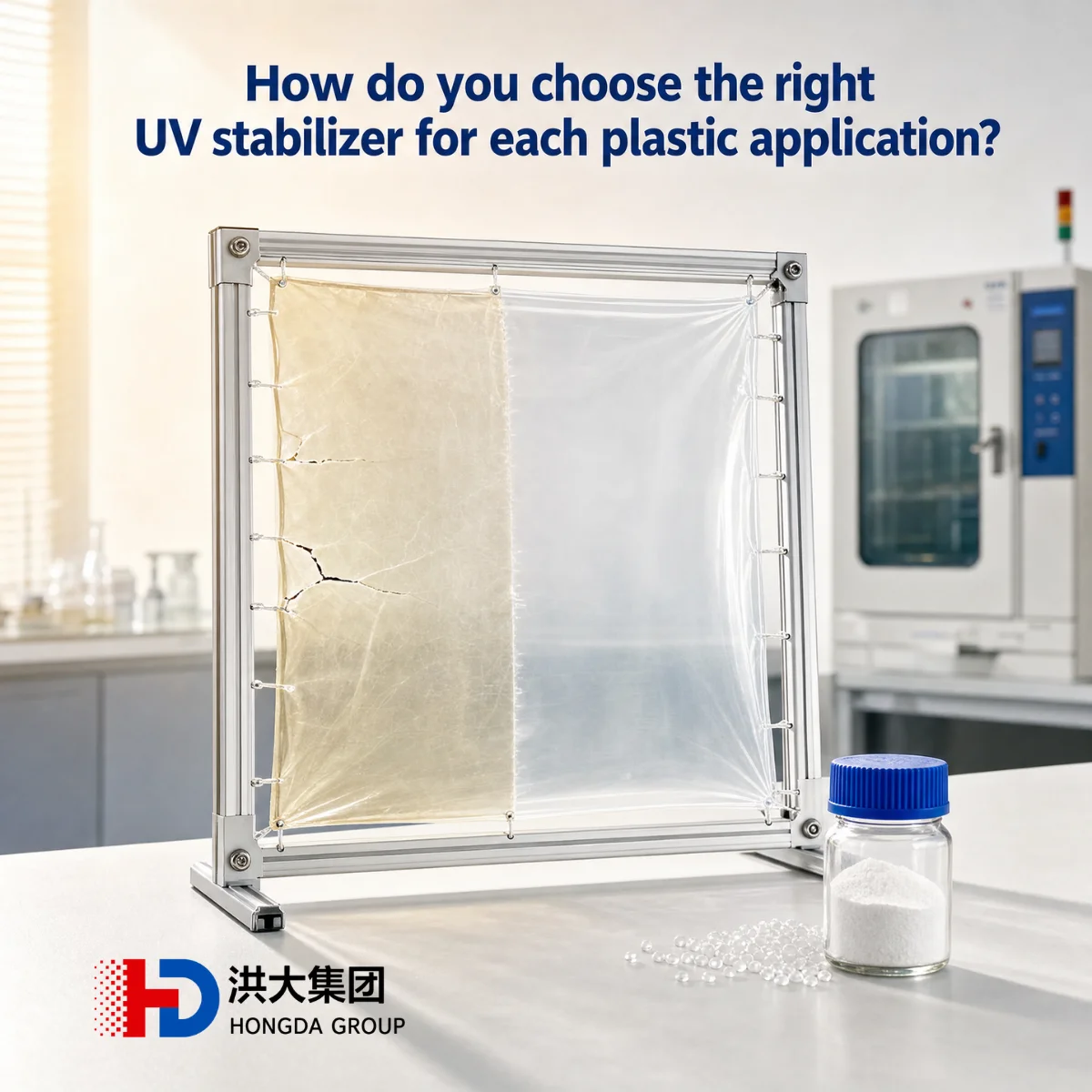
A blown film plant was supplying greenhouse film to a vegetable growing operation. To simplify purchasing, the plant switched the film's light stabilization package to the UV absorber system it had long used in outdoor injection molded parts, without cutting the addition rate, and tensile strength and light transmission all passed at final inspection. Less than halfway through the first growing season, the film began turning brittle across the roof and wherever it touched the hold-down lines and the steel frame, and a single strong wind tore open several greenhouses. The crops inside were left exposed to cold nights and rain, and the grower demanded compensation for the whole season's losses. The same formulation had worked for years in thick-walled molded parts without a single problem, yet in a very thin film the protection a UV absorber can provide becomes very limited.
How do you choose the right UV stabilizer for each plastic application? Plastic UV stabilizers fall into two main classes, UV absorbers and hindered amine light stabilizers, and the two protect the product in different ways. Selection starts with the product's thickness, transparency, processing temperature and service environment, and then moves on to the stabilizer system and the specific grades.
Aging in outdoor plastics begins with the absorption of ultraviolet light. UV radiation can break chemical bonds along the polymer chains, or be absorbed by impurities such as catalyst residues and carbonyl groups and generate free radicals, which then enter the same chain reaction as thermo-oxidative aging, a process we covered in our article on plastic antioxidants. What sets photo-oxidative aging apart is that it is triggered from outside, so the damage concentrates at the surface of the part. Photo-oxidation starts at the surface and works its way inward. Once UV light enters the plastic, its intensity drops quickly, so the outermost layer is always the first to suffer. As surface chains break, the part loses gloss, chalks and develops microcracks; under load, those microcracks become crack initiation points, and impact strength and elongation at break fall sharply. The interior of a thick-walled part may still be intact while the surface damage is already enough to make it crack during handling or in cold weather. In films and fibers, the entire cross section lies within the depth UV light can reach, so they fail faster and more completely. Path length, which depends on the product's thickness, decides which kind of protection works. UV absorbers protect the polymer by absorbing UV light themselves, and how much they absorb depends on their concentration along the light path and on the length of that path. In a thick-walled part the path is long, and the absorber can stop most of the UV radiation just below the surface; in a film the path is very short, and the same loading absorbs far less. The formulation used by the blown film plant at the start of this article worked in thick-walled parts largely because of their thickness.
The common light stabilizers for plastics fall into two main classes, UV absorbers and hindered amine light stabilizers. The first reduces the amount of UV light reaching the polymer, and the second removes the free radicals that have already formed, which is why many outdoor formulations combine the two. UV absorbers convert ultraviolet light into heat. After absorbing UV radiation, an absorber releases the energy as heat through an intramolecular hydrogen bond, returns to its original state and can repeat the cycle again and again. Benzophenones are moderately priced and widely used in polyolefins and PVC; benzotriazoles absorb over a broader range, have a light color and suit a wider range of polymers; triazines combine strong absorption with high heat resistance, which makes them a good fit for engineering plastics processed at high temperatures. Our Chemtechsorb benzophenone range includes grades BP-1, BP-3 and BP-12 (UV-531), the benzotriazole range includes UV-P, 326, 327, 328, 329, 234 and 360, and we also offer 1577, a hydroxyphenyl triazine. Hindered amine light stabilizers remove free radicals in a regenerative cycle. HALS absorb almost no UV light. Under the action of light and oxygen they convert into nitroxyl radicals, which trap alkyl radicals in the polymer and are regenerated in later reactions, closing the cycle. They are consumed slowly and their effect does not depend on path length, so they work just as well in films, fibers and the surface layer of thicker parts. Low molecular weight grades migrate quickly and replenish the surface in time; high molecular weight grades resist volatilization and extraction and give longer-lasting protection. Our Chemtechsorb hindered amines include UV-962 (783), UV-292, UV-123 and UV-765.
Three typical applications fail in three different ways. Agricultural and other films have too short a light path and depend on hindered amines. Light stabilization in film relies mainly on HALS, with UV absorbers as a supplement. Greenhouse film faces harsher conditions: sulfur and chlorine compounds in pesticides break down into acidic substances that bind to the basic hindered amine and deactivate it, and where the film touches the hold-down lines and the steel frame the temperature runs higher, so aging starts there first. These films call for pesticide-resistant, low-basicity hindered amines, and for attention to losses caused by condensation and rain washing over the film, an area where high molecular weight grades have the advantage. In thick-walled outdoor parts, the surface chalks first and cracks then start from the surface. Injection molded parts such as garden furniture, outdoor storage boxes and traffic equipment have thick walls; the UV absorber protects the interior and the color, while the surface layer still needs a hindered amine. The usual approach combines an absorber with HALS and pairs low and high molecular weight hindered amines. The longer the outdoor service life and the stronger the sunlight in the region of use, the larger the share of HALS, and light-colored parts, which have no pigment to shield them, depend on it most. Clear sheet and transparent parts have to block UV light without turning yellow. PC multiwall sheet, PMMA sheet and PET sheet are very sensitive to color. The absorber needs a light color, good compatibility and no haze; these materials are also processed at high temperatures, so the absorber must withstand heat and have low volatility, or it will be lost during extrusion and contaminate the die and rolls. Higher molecular weight grades such as UV-234, UV-360 and UV-1577 are commonly used in these products. PC is sensitive to basic substances, so hindered amines should be used with caution; multiwall sheet is also often coextruded, concentrating a high loading of absorber in a very thin protective surface layer.
Other components in the formulation can make light stabilizers fail early. Hindered amines are basic, so the hydrogen halides released as halogenated flame retardants decompose, the breakdown products of some sulfur-containing additives and acidic fillers can all neutralize them; as we also mentioned in our antioxidants article, thioester antioxidants and certain hindered amines weaken each other. In addition, low molecular weight absorbers volatilize during high-temperature processing, grades with poor compatibility migrate to the surface and bloom, and films and fibers, with their large specific surface area, lose stabilizer faster when liquids wash over them. Selection should weigh molecular weight, compatibility and the actual processing temperature together.
Samples made at the actual thickness and aging data should set the dosage. The addition rate has to account for the product's thickness, its target service life, the intensity of sunlight where it will be used and the other components in the formulation. Make samples at the actual thickness and color and under the actual processing conditions, place them in a xenon arc or fluorescent UV weathering chamber, and measure retention of elongation at break, impact strength, yellowness index and gloss at regular intervals; agricultural film should also be tested with simulated pesticide exposure, and transparent parts need light transmission and haze measurements as well. For products with demanding outdoor service life requirements, we recommend running outdoor exposure tests at the same time, so each set of data can be checked against the other.
Can you use only a UV absorber or only a hindered amine? You can, within a limited range of applications. Thick-walled, dark-colored parts with modest service life requirements can sometimes get by with one; films and fibers rely mainly on hindered amines; transparent parts cannot do without a UV absorber. Most outdoor polyolefin products combine the two, which performs better than the same dosage of a single type. Do black or dark-colored parts still need a light stabilizer? Well-dispersed carbon black is itself an effective UV screen, so black parts need clearly less light stabilizer, although poor dispersion greatly reduces that benefit. Dark parts colored with organic pigments are a different case: the pigments themselves degrade in light, so a light stabilizer is still needed to protect both the polymer and the color. Is there one light stabilizer that works for every outdoor plastic? Each outdoor plastic needs its own combination, because the polymer, thickness, transparency and processing temperature, along with conditions such as pesticides and flame retardants, all change which combination fits best. We first learn about these conditions before recommending a combination of grades, and the final dosage is set by aging tests run on the actual formulation.
Hongda Group has manufactured and exported chemicals in Ningbo since 1992, selling to more than thirty countries. Our Chemtechsorb light stabilizers cover benzophenone, benzotriazole and triazine UV absorbers as well as hindered amine light stabilizers, and they can be used together with our Chemtechnox antioxidants. If you are developing agricultural film, outdoor injection molded parts or clear sheet, or your current outdoor products are chalking, turning brittle or yellowing, tell us about your polymer, part thickness, region of use and service life requirements, and we will work out the light stabilization system together. To learn more about working with us, visit hongda-chem.com and click "Become a strategic partner".