
What Are Disperse Dyes, and Why Do They Work on Polyester?
Disperse dyes are a class of nonionic dyes that are almost insoluble in water. Polyester fiber has no ionic groups that can bind a dye, and its structure is tight and hydrophobic, so water-soluble dyes cannot take hold. Disperse dyes stay suspended in the dyebath as fine particles with the help of a dispersant; at high temperature, as the fiber's molecular chains loosen, they dissolve into the fiber, and once it cools they are locked inside.
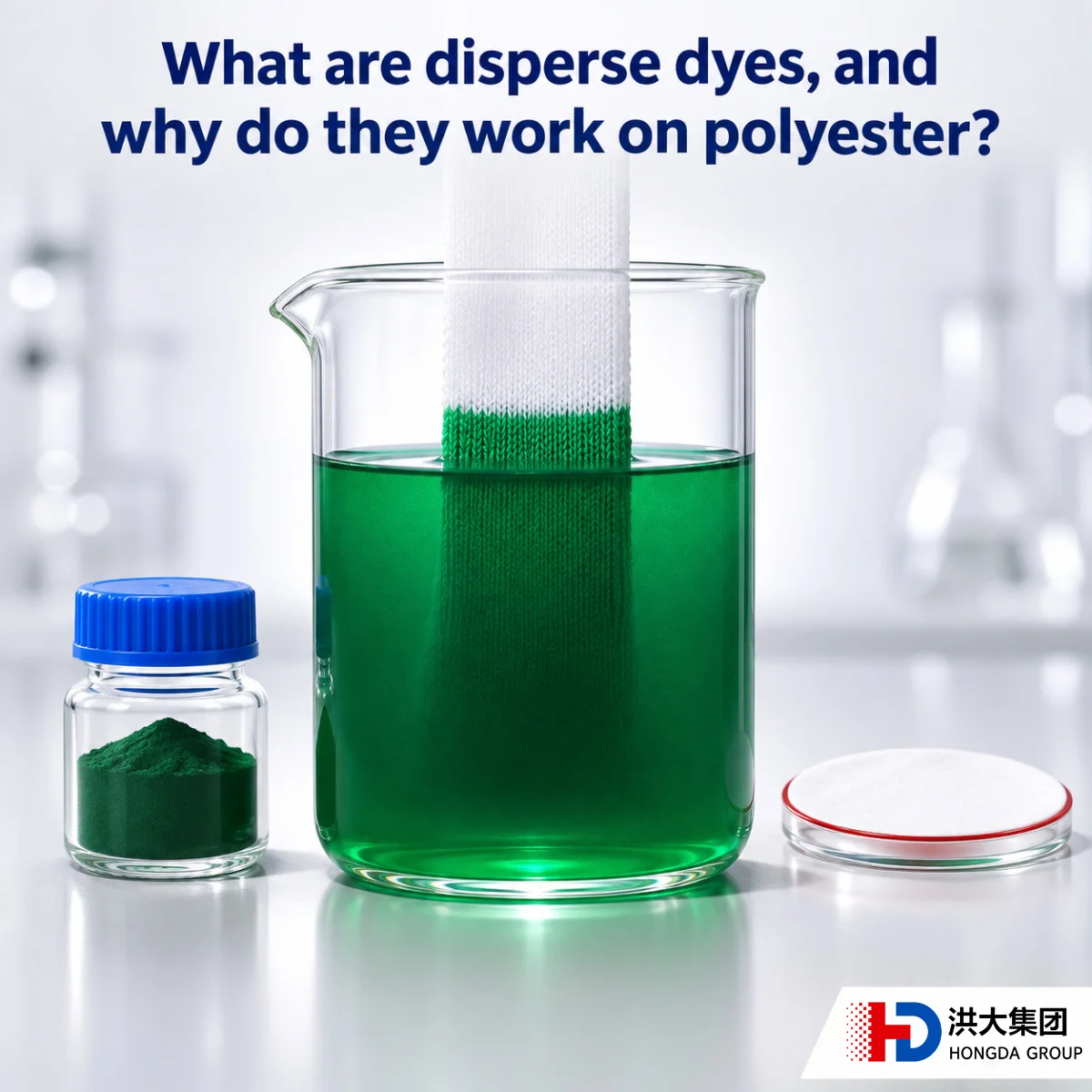
A knitting mill in South Asia that had always worked with cotton and viscose took its first order for polyester sportswear fabric, on a tight delivery schedule. Following its usual practice, the dyehouse made the lab dip with a low-priced disperse black. The lab dip looked acceptable, but when the bulk came out of the high-temperature, high-pressure dyeing machine, the fabric was covered in tiny color specks, the hand was stiff and several rolls differed in depth of shade. The dyehouse stripped and redyed the fabric, and the specks were still there. The whole lot fell outside the acceptance criteria, the order was returned, and the knitting mill lost both the fabric and the customer. When the supplier's technician looked into it afterwards, the problem turned out to lie in the dye's dispersion and in the dyehouse's process curve: the dye had not dispersed fully in the machine, the temperature rose too quickly, and dye particles gathered on the fabric surface before the dye molecules had time to enter the fiber. Polyester and cotton dye by two completely different principles, and the dyehouse ruined its first polyester order by applying what it knew about cotton.
What Are Disperse Dyes, and Why Do They Work on Polyester? Disperse dyes are a class of nonionic dyes that are almost insoluble in water. Polyester fiber has no ionic groups that can bind a dye, and its structure is tight and hydrophobic, so water-soluble dyes cannot take hold. Disperse dyes stay suspended in the dyebath as fine particles with the help of a dispersant; at high temperature, as the fiber's molecular chains loosen, they dissolve into the fiber, and once it cools they are locked inside.
Polyester's fiber structure keeps most dyes out. Polyester's molecular chains carry none of the groups that let a dye react with the fiber or form ionic bonds with it, such as the hydroxyl groups in cotton or the amino groups in wool. The fiber is highly crystalline, its molecular chains are tightly packed and its surface is hydrophobic, so water can barely get in, and dyes dissolved in water even less. Reactive, direct and acid dyes all rely on water-soluble groups to work in water; on polyester they can only sit on the fiber surface and come off at the first wash. To color polyester, you need a dye that can dissolve into the fiber itself and hold on through intermolecular forces, and that dye is the disperse dye.
The three properties of disperse dyes match polyester's three hurdles. Small, uncharged molecules that slip into gaps in the fiber. Disperse dyes have a fairly low molecular weight and no water-solubilizing groups such as sulfonic acid groups in their structure, so they are nonionic overall. Chemically, such molecules resemble polyester, and at high temperature they can dissolve into the amorphous regions of the fiber, the way a solute dissolves into a solvent, forming a solid solution inside the fiber. Dye and fiber are held together by van der Waals forces and hydrogen bonds, with no chemical bond, so the dyeing process is reversible; keep this in mind when we get to fastness further on. Almost insoluble in water, kept in suspension by a dispersant. A dye that does not dissolve in water cannot be made into a solution the way a reactive dye can. Before they leave the factory, commercial disperse dyes are milled and processed together with dispersants into fine particles that form a stable dispersion in water, with the particles staying suspended instead of settling. At any moment, a very small amount of dye is dissolved in the dyebath as single molecules. The fiber keeps absorbing this small dissolved fraction, the particles keep dissolving to replace it, and that is what keeps dyeing going. A dye with poor dispersion clumps together in the machine, and the result is the kind of color specks the dyehouse in the opening story ran into. High temperature loosens the fiber's molecular chains and opens the door. At room temperature, polyester's molecular chains barely move, and the dye cannot get in. Once the temperature rises above the fiber's glass transition temperature, the chains in the amorphous regions start to move, momentary gaps open between chain segments, and dye molecules diffuse in through those gaps. The higher the temperature, the faster the diffusion; when the fiber cools, the chains tighten again and the dye is sealed inside. Every polyester dyeing process comes down to creating this high-temperature window and controlling how evenly the dye enters while it is open.
High-temperature dyeing, thermosol and carrier dyeing: three routes, one mechanism. High-temperature, high-pressure dyeing is the most common method: in a sealed dyeing machine, the dyebath is heated above the boiling point of water and held under pressure for a set time, the molecular chains loosen fully, and the dye gives deep, level shades. It suits loose fiber, yarn and all kinds of woven and knitted fabrics. The thermosol method is used for continuous pad dyeing: the fabric is padded with the dye liquor, dried and then treated briefly with dry heat at an even higher temperature, where the dye sublimes directly into the fiber. It is efficient and suits large volumes of open-width processing. Carrier dyeing adds an auxiliary that swells the fiber at atmospheric pressure, lowering the temperature that dyeing requires. It is mainly used for polyester and wool blends or where no high-temperature equipment is available, but the carrier's odor and residues need extra treatment. The equipment for the three methods is very different, yet the principle is the same: open the fiber, let the dye in, then lock it inside.
Types E, SE and S determine the conditions under which a dye performs well. Disperse dyes are divided into three types by sublimation fastness and molecular size. Type E dyes have small molecules, diffuse quickly and level well, but their sublimation fastness is lower; they suit light and medium shades that need good leveling and processes run at lower temperatures. Type S dyes have large molecules and high sublimation and thermal migration fastness, and suit dark shades, the thermosol method and fabrics that go through high-temperature heat setting later on; their leveling is poor, though, and they demand tighter process control. Type SE sits between the two, balancing leveling and fastness, and is the most widely used. In a combination shade, choose dyes of the same type so their exhaustion rates are close and the color comes out even; mixing types is the most common cause of uneven dyeing and poor reproducibility. We will cover how to tell the three types apart and choose among them in a separate article.
When you buy disperse dyes, check four properties besides color. Dispersion and dispersion stability. This is the property that sets disperse dyes apart from every other dye class. You can check it with a filter paper test: prepare the dye liquor at process concentration, hold it at high temperature for a while, then filter it and look for dye particles and specks left on the paper. Dyes with poor dispersion stability reaggregate as the temperature rises and when salt is added, which shows up as shade differences between dyeing batches, color specks and deposits on the inner walls of the dyeing machine. The milling fineness and the dispersant ratio of a commercial dye determine this property, and the same shade from different sources can differ widely. Build-up and leveling. Build-up describes how far the color keeps deepening as you add more dye. A dye with poor build-up stops deepening beyond a certain concentration, so dark shades can only be forced by piling on more dye, which leaves more surface dye, poorer fastness and higher cost. Leveling describes whether the dye exhausts smoothly as the temperature rises, and whether unevenness can be corrected through migration after dyeing. Run lab dips with the heating rate, holding time and liquor ratio of the bulk process, and the lab dip and the bulk will match. Fastness, especially to sublimation and thermal migration. Disperse dyes have no chemical bond with the fiber, so at high temperature the dye can come back out of the fiber; that is where sublimation and thermal migration come from. Heat setting, pressing, coating and laminating all involve high temperatures, and a dye without enough fastness can stain other fabrics or transfer into the coating. Test fastness to sublimation, washing, rubbing and light with the ISO 105 series of methods, and evaluate the results against the actual finishing temperatures your fabric will see; typical values on a data sheet are only a starting point for screening. Dark and fluorescent shades place higher demands on fastness and need to be confirmed separately. Performance after reduction clearing, and lot-to-lot strength. At the end of dyeing, some dye that never entered the fiber always remains on its surface. It has to be removed by reduction clearing, or wet fastness and rubbing fastness both drop. A good dye keeps a stable shade after reduction clearing, leaves little surface dye and makes clearing easier. Strength and shade consistency from lot to lot matter just as much: commercial dyes need to be standardized before shipping so that every lot is brought to the same strength, or you have to redo lab dips every time a new lot arrives. Every lot of our disperse dyes comes with a test report, key shades have sealed standard samples, and our shade card lists the fastness and suitable processes for each shade, so you can check item by item when you select and accept dyes.
Can disperse dyes be used on cotton or other fibers? Disperse dyes color by dissolving into hydrophobic fibers, so they have almost no affinity for hydrophilic fibers such as cotton, linen and viscose, and whatever does go on washes off. They are suitable for polyester, acetate, nylon and some elastic fibers. Polyester and cotton blends need disperse dyes for one fiber and cotton dyes for the other, usually in a two-bath process or a one-bath, two-step process. Why does the same shade stop matching in dark colors when the lot or source changes? Dye makers standardize the strength of disperse dyes before shipping, each source uses its own standard, and lots can also vary; differences in dispersion and build-up are magnified in dark shades. When you change lots or sources, make side-by-side lab dips with the same recipe and process, compare strength and shade, and then decide whether to adjust the dosage. Our dyed polyester fabric changed color after heat setting. Is the dye to blame? Most likely it is sublimation or thermal migration. At high temperature, disperse dyes can come back out of the fiber, and when the heat-setting temperature is high or the time is long, type E and some type SE dyes can change shade or stain. For fabrics that need high-temperature heat setting, choose a type with high sublimation fastness, and tell your dye supplier the finishing temperature so the dye selection matches the process.
Hongda Group has manufactured and exported textile chemicals and colorants in Ningbo since 1992, selling to more than thirty countries and working with more than five hundred distributors worldwide. Our disperse dyes come in type E, SE and S ranges with a complete shade card listing the fastness and suitable processes for every shade; every lot ships with a test report and a sealed standard sample, and formula advice and comparison samples against your existing standard are part of the partnership from the first order. If you are choosing dyes for polyester fabric, or tracking down color specks, shade differences between batches or shade changes after heat setting, tell us your fabric, process, finishing temperature and target color, and our textile dyes business unit will recommend suitable shades and arrange samples. To learn more about working with us, visit hongda-chem.com, click "Become a strategic partner" and contact us via WhatsApp or WeChat.