
What Do ISO 9001 and ISO 14001 Certifications Mean When Buying Dyes and Pigments?
ISO 9001 certifies a supplier's quality management system, and ISO 14001 certifies its environmental management system; both address how the organization operates. Whether a dye or pigment meets specification and can be sold into a given market has to be confirmed with certificates of analysis, safety data sheets and test reports.
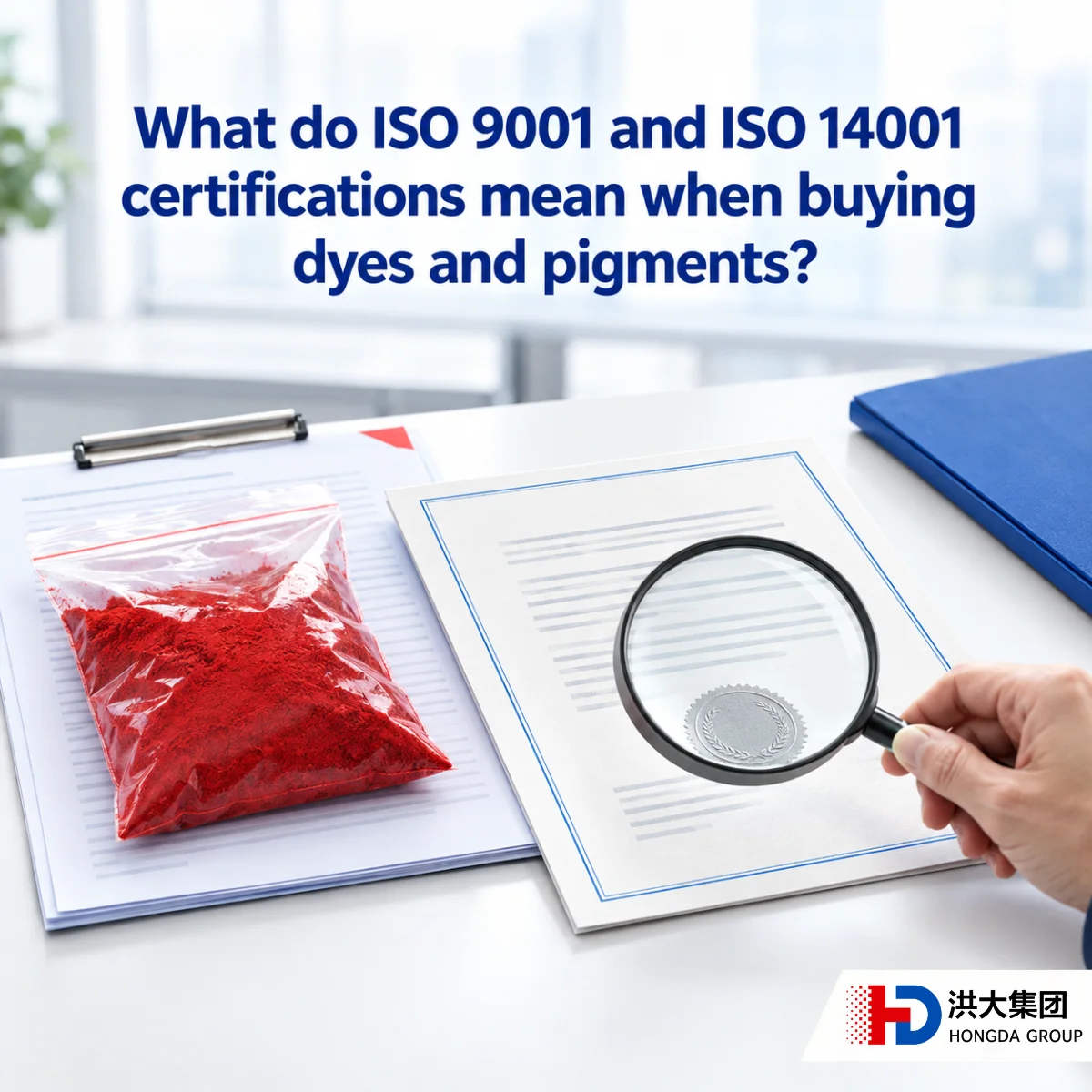
A masterbatch producer received an order for toy components, and the finished toys were bound for export to Europe. To cut costs, its purchasing team switched to an organic pigment supplier with a lower quote. The supplier sent scanned copies of its ISO 9001 and ISO 14001 certificates, purchasing approved it in the supplier audit on that basis, and apart from a product description, no other documents were requested. The shade and tinting strength of the first pigment shipment were close to the sample, the masterbatch was delivered on time, and the toy maker molded the parts and shipped them out in containers. When the European importer ran spot checks, migration of certain elements from the toy parts exceeded the EN 71-3 limits, the entire toy shipment was held at the port, and the toy maker filed a claim against the masterbatch producer. Only when the masterbatch producer went back through the documents did it find that the ISO 9001 certificate had expired long before and that the company name on the ISO 14001 certificate did not match the company on the invoice; and no management system certificate of any kind can prove that a pigment is suitable for use in toys.
What do ISO 9001 and ISO 14001 certifications mean when buying dyes and pigments? ISO 9001 certifies a supplier's quality management system, and ISO 14001 certifies its environmental management system; both address how the organization operates. Whether a dye or pigment meets specification and can be sold into a given market has to be confirmed with certificates of analysis, safety data sheets and test reports.
Treating a management system certificate as proof that a product conforms is a common mistake in purchasing. In dye and pigment purchasing, ISO 9001 and ISO 14001 are often used as a threshold for approving suppliers. That use makes sense; the risk lies in treating the certificates as a guarantee for every shipment. Both certificates are issued by certification bodies and prove that an organization's management system has been audited and meets the requirements of the standard. Each one states the certified organization, its address, the version of the standard, the scope of certification and the validity period. They answer the question "how does this supplier operate?"; the tinting strength, heavy metal content and suitable applications of a particular pigment batch have to be answered by other documents.
ISO 9001 tells you whether a supplier can consistently deliver the same product. What the standard actually requires is process control, traceability and corrective action. ISO 9001 is the quality management system standard; the current version is ISO 9001:2015, and its Chinese national equivalent is GB/T 19001-2016. It requires a company to define customer requirements, control processes such as purchasing, production, inspection and delivery, keep records, handle nonconforming products, analyze root causes and take corrective action, and carry out regular internal audits and management reviews. For dyes and pigments, this means incoming inspection of raw materials, batch production records, comparing shade and strength against a standard sample, keeping retained samples, and investigating and responding to complaints. For buyers, its value is that when a batch deviates, the supplier has a way to trace the cause and keep the same problem from happening again. Specifications, however, depend on what you and the supplier agree on in advance. Parameters such as shade, tinting strength, fineness, moisture, heat resistance and heavy metal content are written into the technical data sheet and the purchase contract; ISO 9001 requires the supplier to build a system that can consistently meet what was agreed. The more specific the agreement, the more the system can do for you; if the contract only says "same as sample," neither side has much to check against when a dispute arises.
ISO 14001 matters because a plant's environmental risks can become your supply risks. The system has to keep wastewater, air emissions and compliance obligations under control. ISO 14001 is the environmental management system standard; the current version is ISO 14001:2015, with GB/T 24001-2016 as its Chinese equivalent. It requires a company to identify the environmental aspects of its production and the regulations it must comply with, set objectives, control its operations, prepare for emergencies and monitor continuously. Dye and pigment production involves colored wastewater, saline wastewater, air emissions and hazardous chemicals, and if environmental management gets out of control, a plant can be ordered to stop production until the problems are fixed. Environmental inspections have shut down some dye and intermediate plants in the past, and downstream users faced shortages and price increases for a while. What buyers gain is supply continuity and support in brand audits. For buyers, the main value of ISO 14001 lies in supply continuity: plants with solid environmental compliance are less likely to shut down suddenly over environmental issues. More and more brand owners also ask upstream suppliers for evidence of environmental management when they audit their supply chains. Limits on hazardous substances in the product itself are a separate matter that has to be proven with test reports and regulatory declarations, and an ISO 14001 certificate does not cover that.
Checking a certificate means looking at three things. The first is the issuing body and the accreditation marks. The certificate should be issued by an accredited certification body and usually carries the mark of the accreditation body along with the multilateral recognition mark of the International Accreditation Forum (IAF). Management system certificates issued in China can be looked up by certificate number on the official website of the Certification and Accreditation Administration of the People's Republic of China (CNCA), and the result should match the certificate, including whether it is currently valid, suspended or withdrawn. The second is the certified organization and the scope of certification. The name and address of the certified organization should match the company on the contract and the invoice, and the plant that actually ships the goods. One certificate can cover several companies within a group, and each one is listed individually. The scope states the product categories and business activities the system covers, and the dyes or pigments you buy need to fall within it. The third is the version of the standard and the validity period. Management system certificates are generally valid for three years, with a surveillance audit every year, and they can only be renewed by passing a recertification audit before they expire. The certificate should reference the current version of the standard, and its validity period should cover your purchasing cycle. If the version is outdated, the certificate has expired, or the supplier can only produce a scan from years ago, ask for the latest certificate and look it up again.
Beyond the certificates, each shipment needs other documents. The technical data sheet and the certificate of analysis cover the specification and the measured values for that batch. The technical data sheet (TDS) describes a product's typical properties, the systems it suits and the recommended dosage, and tells you whether a grade can be used at all; the certificate of analysis (COA) corresponds to a specific batch number and lists the measured results for that batch, such as the deviation in shade and tinting strength from the standard sample, moisture and fineness, and tells you whether that batch can be accepted. The batch number on the COA should match the one on the packaging. When goods arrive, spot-check them against the COA and keep a retained sample, so you have something to rely on if a dispute comes up later. The safety data sheet and regulatory documents are the basis for transport, storage and import. The safety data sheet (SDS, also called MSDS) is prepared under the Globally Harmonized System of Classification and Labelling of Chemicals (GHS) and has 16 sections covering hazard identification, composition, first aid, storage, transport and regulatory information; it is a required document for customs clearance, transport and handling on the shop floor. For products exported to the EU, confirm that the relevant substances have been registered under REACH; if the target market has its own chemical inventory or registration requirements, check those in advance as well. Test reports should be requested according to the end use. When a pigment goes into toys, food contact materials or electrical and electronic equipment, request test reports against requirements such as EN 71-3, EU AP(89)-1 and RoHS respectively; our ultramarine blue range, for example, comes with FDA, EU AP(89)-1 food contact, RoHS and EN 71-3 certifications. For textile dyes exported to the EU, watch for the restricted aromatic amines that azo dyes can break down into, and brand owners usually have their own restricted substances lists as well. Fastness data for dyes also needs a clear basis: every fastness value in our textile dye brochures corresponds to a specific ISO or AATCC test method.
Does ISO 14001 certification mean a supplier's pigments are more environmentally friendly? These are two separate questions. ISO 14001 shows that the plant controls the emissions from its production and its compliance obligations through an environmental management system; heavy metals, restricted substances and migration in a pigment depend on test reports and regulatory declarations for the specific grade. If a supplier has ISO 9001, do you still need a certificate of analysis for every shipment? Yes. ISO 9001 requires the supplier to have an inspection and release process, and the COA is the result that process produces for a specific batch. Only by checking the COA item by item against the contract specification and the retained sample when the goods arrive can you confirm that the batch conforms. The certificate is about to expire; can you keep placing orders? You can keep ordering, and at the same time ask the supplier to explain its recertification audit schedule or provide the new certificate. A certificate is valid for its entire validity period; if it has expired and the supplier cannot produce a new one, first find out whether it was suspended or withdrawn because a surveillance audit was not passed.
Hongda Group has manufactured and exported chemicals in Ningbo since 1992, selling to more than thirty countries. The group is certified to ISO 9001 for its quality management system and ISO 14001 for its environmental management system, and both certificates can be viewed on hongda-chem.com by clicking their logos. Technical data sheets and safety data sheets for our dyes, pigments and titanium dioxide are available grade by grade. If you are auditing a new dye or pigment supplier, or preparing to sell into a market with stricter documentation requirements, tell us about the application, the target market and the list of documents you need, and we will go through them with you item by item. To learn more about working with us, visit hongda-chem.com, click "Become a strategic partner" and contact us via WhatsApp or WeChat.