
What Are Plastic Antioxidants, and Why Do Plastic Products Need Them?
Plastic antioxidants are additives blended into polymers to interrupt the chain reaction of thermo-oxidative aging. They protect the melt from degrading during processing and slow down embrittlement, yellowing and cracking during storage and use. They are used in very small amounts, yet they decide how long a plastic product lasts.
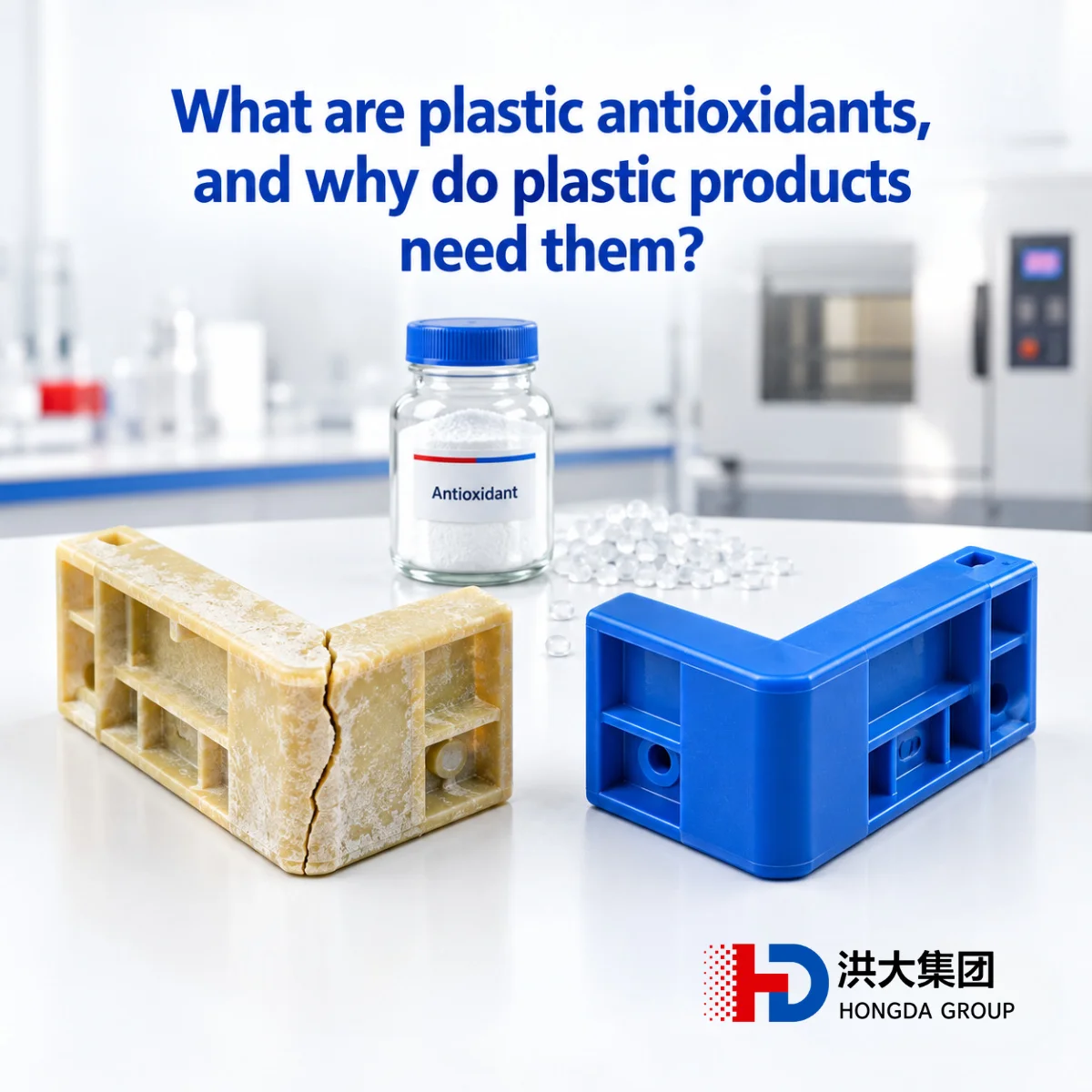
An injection molder was producing polypropylene crates for a logistics customer. To hold down costs, the shop blended a share of sprues, runners and ground regrind into the virgin resin, and because a new mold had been installed, the barrel temperature was also raised a little. At final inspection, dimensions, color and falling-weight impact all passed. One summer later, the crates in the customer's warehouse began failing in batches: corners broke off in whole pieces when forklifts handled them, and the surfaces turned yellow and chalked at the touch of a hand. The customer demanded a full recall and filed a claim. The resin grade and the color masterbatch were the same as before. What had changed was the thermal history the polypropylene went through in the molten state, and the small dose of antioxidant in the formulation that was there to protect it had long since been used up by repeated processing.
What are plastic antioxidants, and why do plastic products need them? Plastic antioxidants are additives added to polymers to interrupt the chain reaction of thermo-oxidative aging. During processing they keep the melt from degrading, and during storage and use they delay embrittlement, yellowing and cracking. The dosage is very small, yet it decides how long a plastic product will last.
A polymer's most dangerous moment comes before the part is even formed, inside the barrel: temperatures above 200°C, intense screw shear and the small amount of oxygen dissolved in the melt are enough to start oxidation within minutes. The part looks perfectly normal when it leaves the plant, while its molecular chains have already been damaged. The free radical chain reaction accelerates itself once it starts. Heat and shear break polymer chains and generate alkyl radicals. An alkyl radical that meets oxygen immediately becomes a peroxy radical; the peroxy radical then pulls a hydrogen atom from a neighboring chain, forming a hydroperoxide and leaving behind a new alkyl radical. Worse still, the hydroperoxide itself is highly unstable and decomposes under heat into new radicals, multiplying the reaction rate. This is the signature of thermo-oxidative aging: almost no visible change at first, and once a critical point is crossed, properties collapse in a very short time. Chain scission and crosslinking are two very different ways of failing. Oxidation affects different polymers differently. In polypropylene, the tertiary carbon atoms along the chain are the most vulnerable, so chain scission dominates: molecular weight drops, melt flow rate rises, the part turns brittle and impact strength falls sharply, which is exactly what happened to the crates at the start of this article. Polyethylene is more prone to crosslinking: melt flow rate drops, gels and fish-eyes appear in blown film, and the film surface turns rough and tears easily.
The consequences of thermo-oxidative aging are spread over three stages of a product's life cycle, and the later they appear, the higher the cost. In processing, the symptoms are melt index drift, gels and discoloration: during extrusion and injection molding, an under-protected melt keeps changing viscosity, so process settings need readjusting as soon as they are dialed in, films show fish-eyes, pipe bores come out rough and parts carry a yellow cast. Problems at this stage can at least be caught and stopped on the shop floor. In storage and use, the symptoms are yellowing, embrittlement and surface crazing: parts keep absorbing heat in the warehouse and in service, the remaining antioxidant is consumed bit by bit, and once it is gone, embrittlement and cracking arrive all at once. These failures often surface only months after delivery, they are the hardest to trace and they bring the heaviest customer claims. With regrind and repeated processing, protection runs out early. Antioxidants are sacrificial additives: every radical they trap and every peroxide they decompose uses up part of them. Sprues and runners, ground regrind and recycled resin have been through more than one heat history, and their remaining protective capacity is often already low. Blending them in at a fixed ratio without topping up the antioxidant amounts to putting partly aged material into a new product.
Antioxidants fall into two broad classes by mechanism. Each breaks a different link in the chain reaction, which is why most formulations use both. Hindered phenols are the most widely used primary antioxidants and work by trapping radicals. Their molecule carries a reactive hydrogen atom that it donates to a peroxy radical, turning it into a hydroperoxide while the phenol itself becomes a stable phenoxy radical, and the chain reaction stops there. The hydroperoxide formed is still a hazard, and that is the part secondary antioxidants deal with. Our Chemtechnox hindered phenol range includes grades 1010, 1076, 1098 and 3114. Phosphite and thioester secondary antioxidants decompose hydroperoxides into stable products, keeping them from splitting into new radicals. Phosphites are highly efficient at processing temperatures, protect mainly the melt and reduce discoloration during processing; thioesters perform better in long-term heat aging and are common in parts that must withstand heat for long periods. In our product line, the phosphites are 168 and 626, and the thioester is 300. Blends work better than single antioxidants because of synergy: the primary antioxidant traps radicals, the secondary antioxidant removes peroxides, and when they work together the primary antioxidant is consumed more slowly, so the overall result is clearly better than the same dosage of either one alone. We offer two blended products, 215 and 900, so you can skip weighing two powders separately on the shop floor, and the ratio stays more consistent from batch to batch.
Three conditions are the easiest to overlook when selecting an antioxidant. The first is the combination of polymer, processing temperature and service temperature. Polypropylene needs more protection than polyethylene, and nylon, ABS and polyester each have grades suited to them. The higher the processing temperature and the longer the residence time, the greater the need for secondary antioxidant; parts that work at elevated temperature for long periods, such as hot water pipe, also need a thioester for long-term heat stability. The second is gas fading in light-colored parts. Hindered phenols can form colored quinone products when they oxidize. Forklift exhaust and gas-fired heaters in warehouses release nitrogen oxides, and white or light-colored parts stored in that environment develop the yellowing the trade calls gas fading. Selection for light-colored products should take this into account, with attention to storage conditions. The third is interaction with other additives and pigments. In a formulation, antioxidants coexist with light stabilizers, flame retardants, pigments and fillers. Some pigments and fillers adsorb antioxidants or bring in metal impurities that promote oxidation, and thioesters used together with certain hindered amine light stabilizers can weaken each other.
Passing final inspection still leaves three validations to run. The common methods are these: measure melt flow rate and yellowness index after multiple extrusion passes to judge processing stability; measure oxidation induction time by differential scanning calorimetry to compare the remaining antioxidant capacity; and place test bars in a heat aging oven and record the time until embrittlement to assess long-term heat resistance. For formulations that include recycled material, run all three tests at the actual blending ratio.
Is more antioxidant always better? Only up to a point. Beyond the required dosage, the gain in performance is limited while cost keeps rising, and excess antioxidant can migrate to the surface of the part and cause blooming, which affects printing, bonding and appearance. The right dosage should be set through multiple-pass extrusion and heat aging tests. Is extra antioxidant needed when using recycled material? Usually yes. Recycled material has already been through processing and service, and a substantial share of its original antioxidant has been consumed. The amount to add should be based on the regrind ratio, its source and the measured oxidation induction time, since estimates from experience alone easily fall short. Can antioxidants replace UV stabilizers? The two address different sources of aging. Antioxidants mainly counter aging caused by heat and oxygen, while photo-oxidative aging caused by ultraviolet light calls for UV absorbers and hindered amine light stabilizers. Outdoor products need both systems working together, and our Chemtechsorb range supplies both types of light stabilizer.
Hongda Group has manufactured and exported chemicals in Ningbo since 1992, selling to more than thirty countries. Our Chemtechnox antioxidants cover processing stabilization and long-term heat stabilization for PE, PP, PA, PVC, ABS and polyester. If your parts are showing yellowing, embrittlement or melt index drift, or you are preparing to raise your regrind ratio, tell us about your polymer, processing conditions and service environment, and we will work out the right antioxidant system together. To learn more about working with us, visit hongda-chem.com and click "Become a strategic partner".